This section helps you review the main OSPF concepts for the exam.
Main points to remember
OSPF is a link-state routing protocol that uses Dijkstra’s algorithm.
The metric is based on cost, calculated from interface bandwidth. You can review this in OSPF Metric Cost.
Routers exchange LSAs to describe network links and build a complete topology view.
The router ID follows a specific selection order — see OSPF Router ID.
Routers pass through several neighbor states before forming an adjacency, explained in OSPF Neighbor States.
On multi-access networks, a DR and BDR are elected — learn more in OSPF DR and BDR.
The passive interface command stops OSPF from sending Hello packets on certain interfaces. See OSPF Passive Interface.
OSPF can advertise a default route to other routers. This is covered in OSPF Default Route.

OSPF – Practical Configuration
After reviewing the key points, the next step is to practice OSPF configuration in a lab environment.
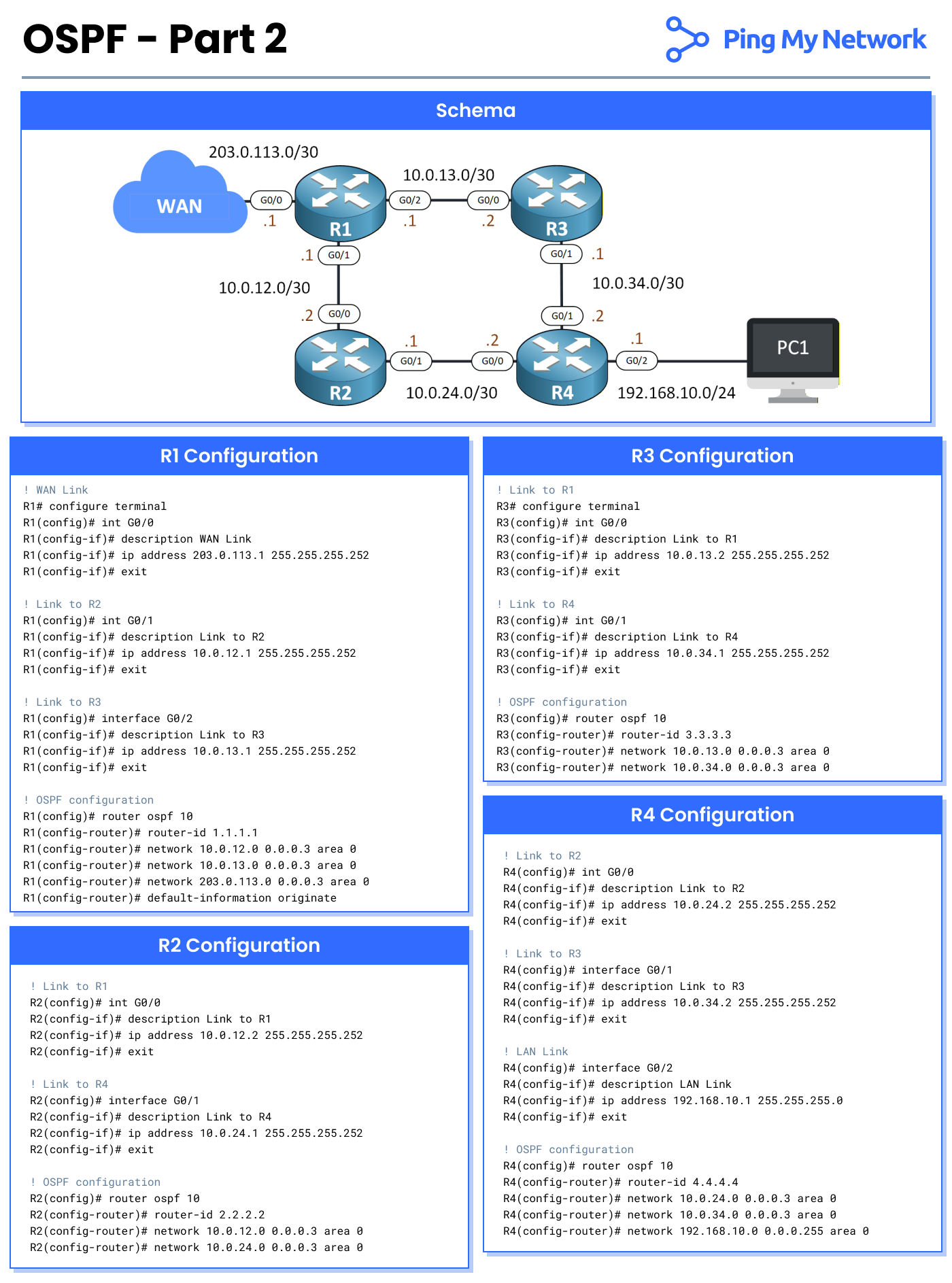
Answer the question below
OSPF CheatSheet
This page provides the complete OSPF CheatSheet for the CCNA 200-301 exam.
It gathers the essential points to remember and the configurations to practice before your final review.