In the previous lesson, you displayed the LSDB of R1.
One section was left unexplained: Summary Net Link States.
These are the Type 3 LSAs.A Type 3 LSA is generated by an Area Border Router (ABR).
It is used to advertise networks from one area into another area.Type 3 LSA Scope
Type 3 → Inter-area scope
Type 3 LSAs advertise networks, not routers.
They allow routers in different areas to learn about networks that exist outside their local area.
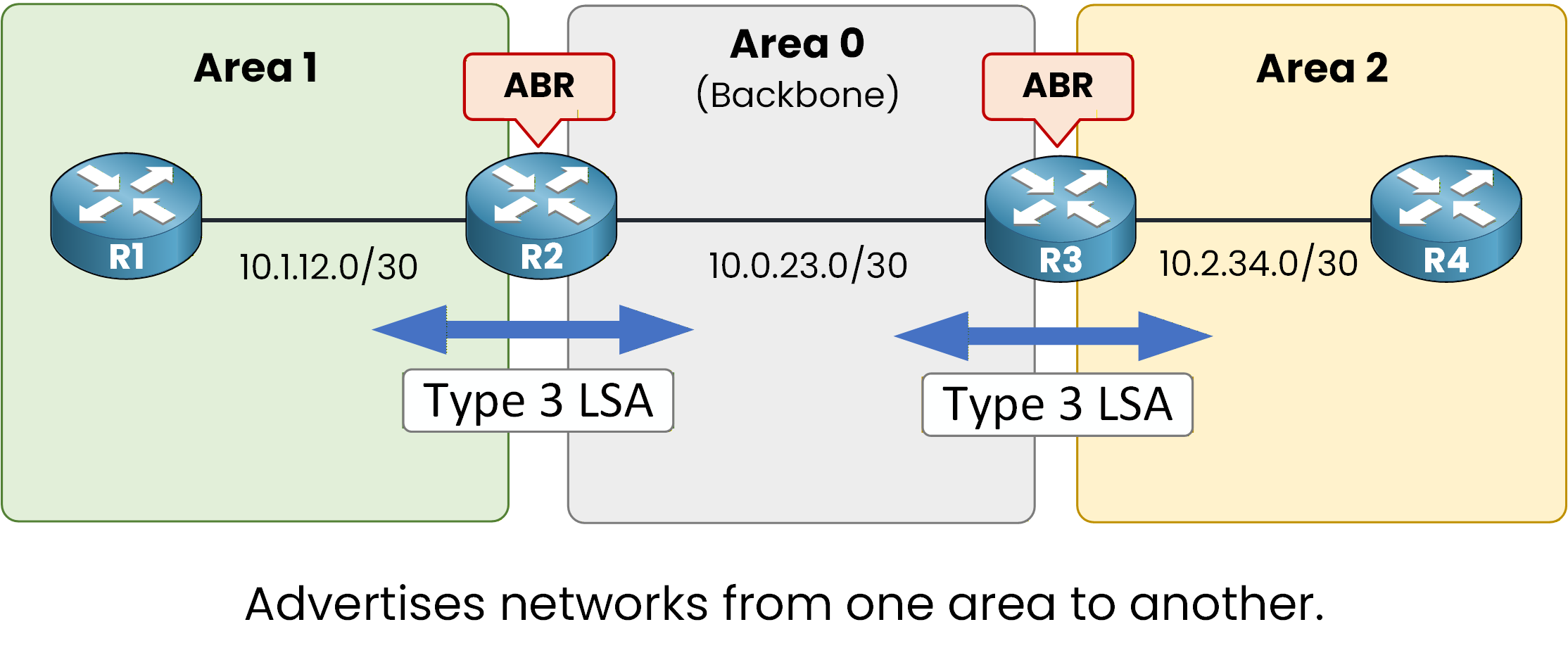
Figure 1 - Type 3 LSA
Without Type 3 LSAs, each area would only know its internal topology.
Answer the question below
What is the acronym for the router that generates a Type 3 LSA?
Verifying a Type 3 LSA
We can verify a Type 3 LSA using the following command:
R1# show ip ospf database summary

Summary Net Link States (Area 1)

  Link State ID: 10.0.23.0 (summary Network Number)
  Advertising Router: 2.2.2.2
Here, we can see:
The Link State ID represents the advertised network (10.0.23.0).
The Advertising Router is 2.2.2.2, which is the ABR (R2).
This means R1, located in Area 1, learned about the 10.0.23.0 network from another area through the ABR.
And in the routing table, you already know how these networks appear:
R1# show ip route ospf
Codes: O - OSPF, IA - OSPF inter area
       E1 - OSPF external type 1, E2 - OSPF external type 2

Gateway of last resort is not set

      10.0.0.0/8 is variably subnetted, 5 subnets, 3 masks
O IA     10.0.23.0/30 [110/2] via 10.1.12.2, 01:28:14, GigabitEthernet0/0
O IA     10.2.34.0/30 [110/3] via 10.1.12.2, 01:27:04, GigabitEthernet0/0
O IA     10.2.100.0/24 [110/4] via 10.1.12.2, 00:17:39, GigabitEthernet0/0
These routes were installed because of Type 3 LSAs.
The ABR receives the Type 1 and Type 2 LSAs of one area, and generates one Type 3 LSA per network into the other area. This is what creates the O IA routes.Answer the question below
Which routing table code indicates routes learned via Type 3 LSAs?
There is another important concept you need to understand: the ASBR.
An ASBR (Autonomous System Boundary Router) is a router that connects OSPF to an external routing domain.An ASBR can exist in any area.
The ASBR Role
This router sits at the boundary between OSPF and an external autonomous system.
It allows OSPF to exchange routing information with networks outside the OSPF domain.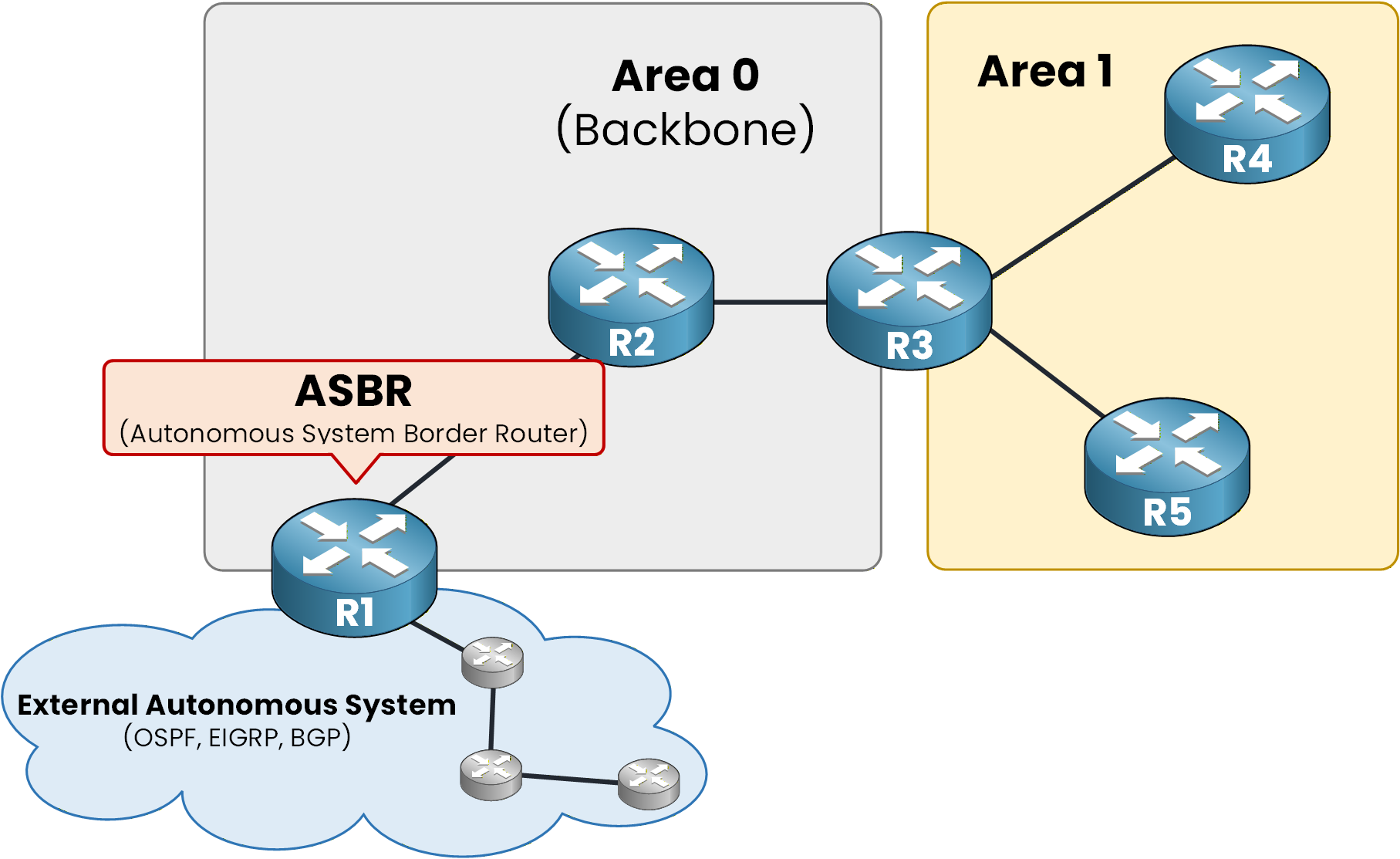
Figure 2 - ASBR Router
An ASBR is responsible for:
Learning routes from outside OSPF
Injecting external routes into the OSPF domain
Redistributing routes from other sources (static, connected, or other routing protocols)
This process is called route redistribution.
Answer the question below
The process of injecting routes from other sources into OSPF is called route ______________.
We now move to Type 5 LSAs because you must understand Type 5 before understanding Type 4.
A Type 5 LSA is generated by an ASBR.
When an ASBR redistributes an external route, it generates a Type 5 LSA.
In the topology below, R1 is now the ASBR: it connects OSPF to an external autonomous system.Type 5 LSA Scope
Type 5 → Domain-wide scope
Type 5 LSAs describe external networks, not routers.
They are flooded throughout the entire OSPF domain (except stub areas, which you do not need to understand in detail at this stage).
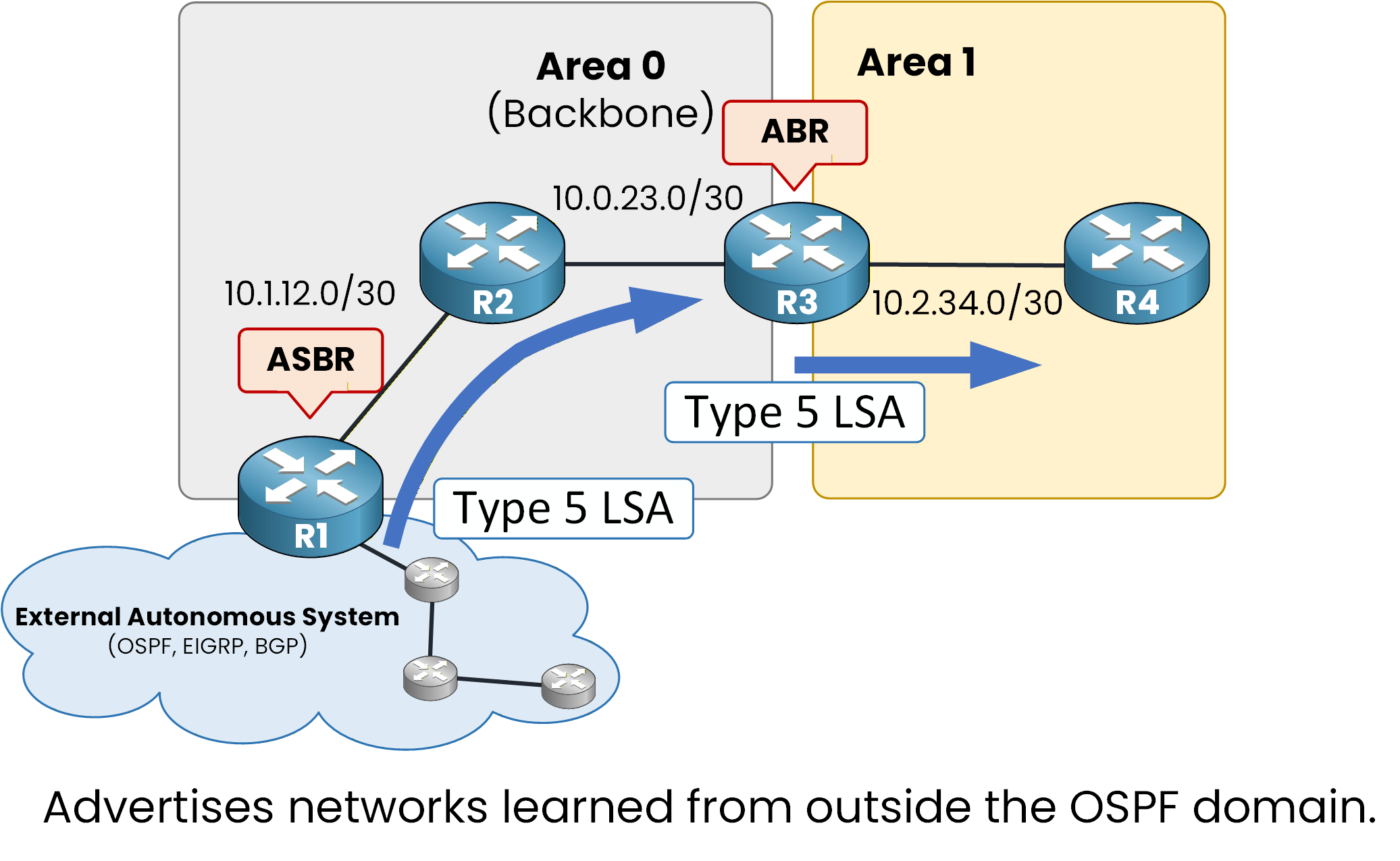
Figure 3 - Type 5 LSA
Answer the question below
Which router generates a Type 5 LSA?
Verifying a Type 5 LSA
We can verify a Type 5 LSA using the following command:
R3# show ip ospf database external

            OSPF Router with ID (3.3.3.3) (Process ID 1)

                Type-5 AS External Link States

  Link State ID: 172.16.1.0 (External Network Number)
  Advertising Router: 1.1.1.1
Here we can see:
The Link State ID represents the external network (172.16.1.0).
The Advertising Router is 1.1.1.1, which is the ASBR.
Now let's look at the routing table:
R3# show ip route ospf
Codes: O - OSPF, IA - OSPF inter area
       E1 - OSPF external type 1, E2 - OSPF external type 2

Gateway of last resort is not set

      10.0.0.0/8 is variably subnetted, 5 subnets, 2 masks
O        10.1.12.0/30 [110/2] via 10.0.23.1, 00:12:44, GigabitEthernet0/0
      172.16.0.0/24 is subnetted, 1 subnets
O E2     172.16.1.0/24 [110/20] via 10.0.23.1, 00:05:18, GigabitEthernet0/0
Notice the code O E2.
By default, routes redistributed by an ASBR are installed as E2 routes.
(Metric behavior between E1 and E2 is covered in the OSPF Best-Path Selection lesson.)Answer the question below
By default, redistributed routes are installed as which route type?
Type 5 LSAs advertise the external networks. But routers in other areas also need to know how to reach the ASBR itself.
A Type 4 LSA is generated by an ABR.
An ABR advertises the location of the ASBR into other areas.Type 4 LSA Scope
Type 4 → Inter-area scope
Type 4 LSAs describe the ASBR, not networks.
They are flooded into other areas so routers know how to reach the ASBR.
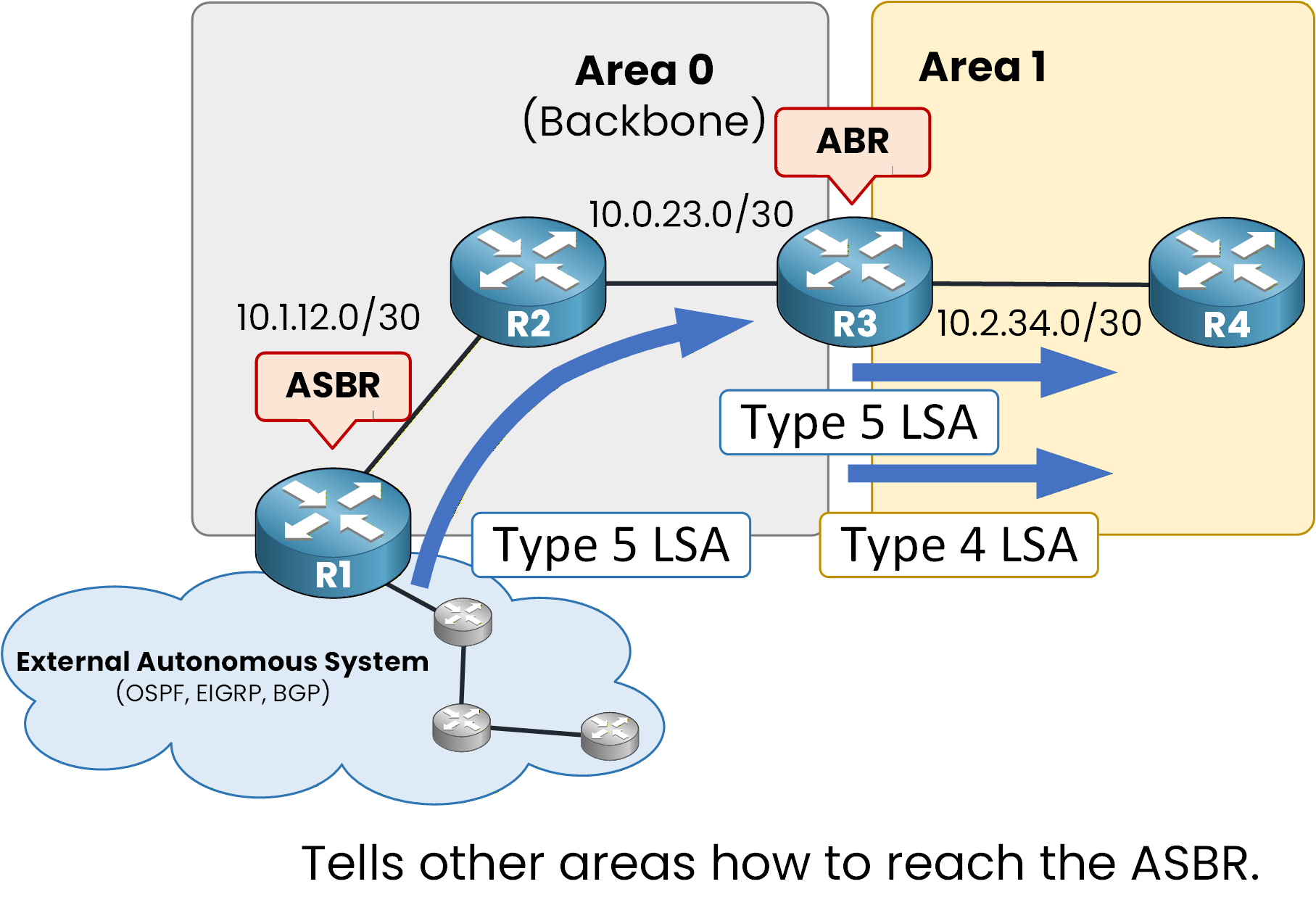
Figure 4 - Type 4 LSA
When an ASBR generates a Type 5 LSA to advertise an external network, routers must also know how to reach that ASBR.
The ABR generates a Type 4 LSA to provide the path to the ASBR.Answer the question below
What does a Type 4 LSA describe?
Verifying a Type 4 LSA
We can verify a Type 4 LSA directly on R4, which sits in Area 1:
R4# show ip ospf database asbr-summary
            OSPF Router with ID (4.4.4.4) (Process ID 1)

                Summary ASB Link States (Area 1)

  LS Type: Summary Links(AS Boundary Router)
  Link State ID: 1.1.1.1 (AS Boundary Router address)
  Advertising Router: 3.3.3.3
  Network Mask: /0
        TOS: 0  Metric: 2
Key points:
The Link State ID is the ASBR Router ID (1.1.1.1).
The Advertising Router is the ABR, R3 (3.3.3.3).
This means:
The ABR is informing Area 1 how to reach the ASBR.So:
Type 5 → tells us what the external network is.
Type 4 → tells us how to reach the ASBR that originated it.
You now know the five LSA types.
An ABR generates one Type 3 LSA per network. In the next lesson, you will reduce that number with summarization.Answer the question below
In a Type 4 LSA, the Link State ID is the router ID of the ___.