SVI InterVLAN Routing is a method that allows Layer 3 switches to route traffic between VLANs without relying on an external router.
Before going deeper, you might wonder: What exactly is a Layer 3 switch?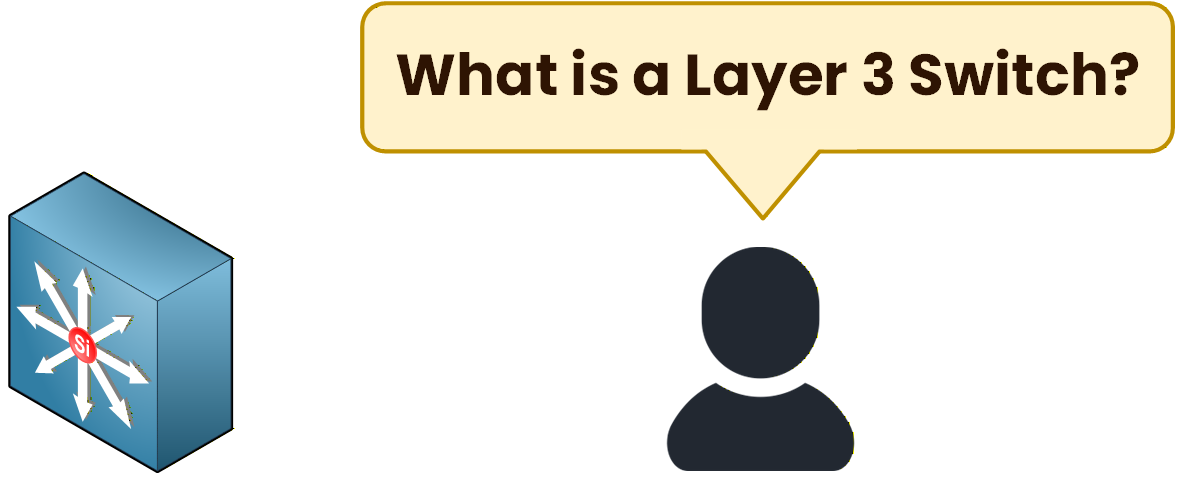
Figure 1 – Layer 3 switch concept
Layer 3 Switch Concept
A Layer 3 switch looks like a standard switch, but it can also perform routing.
It handles:Layer 2 switching for forwarding frames.
Layer 3 routing, directly in hardware using ASICs.
Because routing happens in hardware instead of software (like on a router), the performance is significantly higher.
This is why modern networks rely on Layer 3 switches to route traffic between VLANs efficiently.To achieve this routing capability, the switch uses SVIs.
What is an SVI?
An SVI (Switched Virtual Interface) is a virtual Layer 3 interface created for a specific VLAN on a Layer 3 switch.
Each VLAN has its own SVI, and that SVI becomes the default gateway for every device inside that VLAN.Let’s look at the topology together:
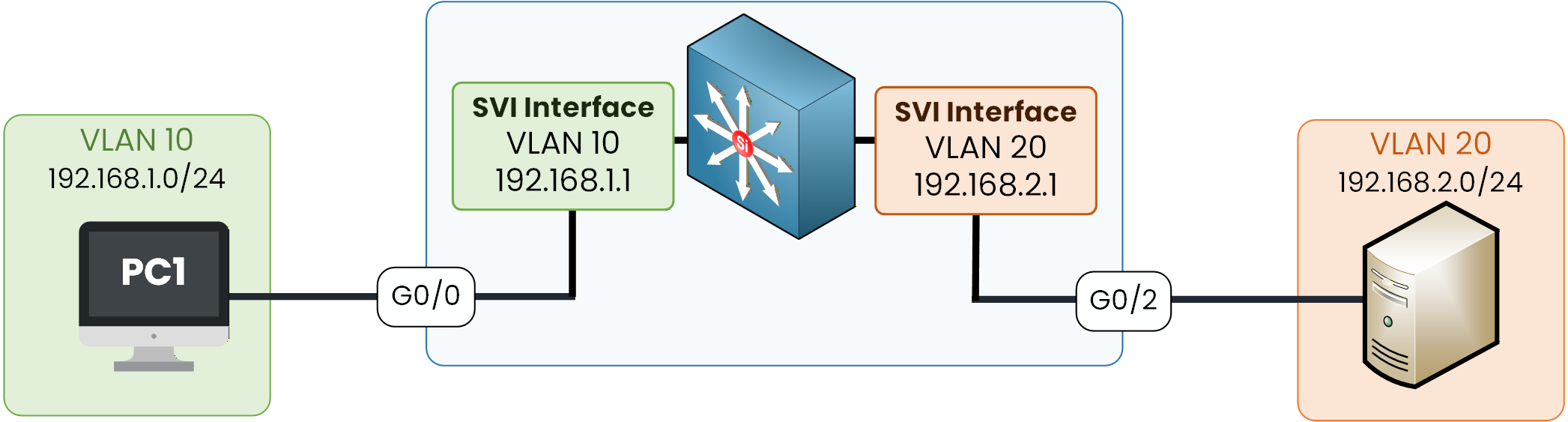
Figure 2 – SVI routing topology
In this setup:
A Layer 3 switch connects devices in VLAN 10 and VLAN 20
Each VLAN has its own SVI, acting as the default gateway:
SVI for VLAN 10 → 192.168.1.1
SVI for VLAN 20 → 192.168.2.1
These SVI interfaces serve as the Layer 3 gateways, allowing the switch to route traffic internally between VLAN 10 and VLAN 20 without using any external router.
This is the modern and recommended method for inter-VLAN communication in enterprise networks.
Answer the question below
Which device type performs Layer 3 routing in this method?
Now that you understand what an SVI is, let’s walk through the configuration together.
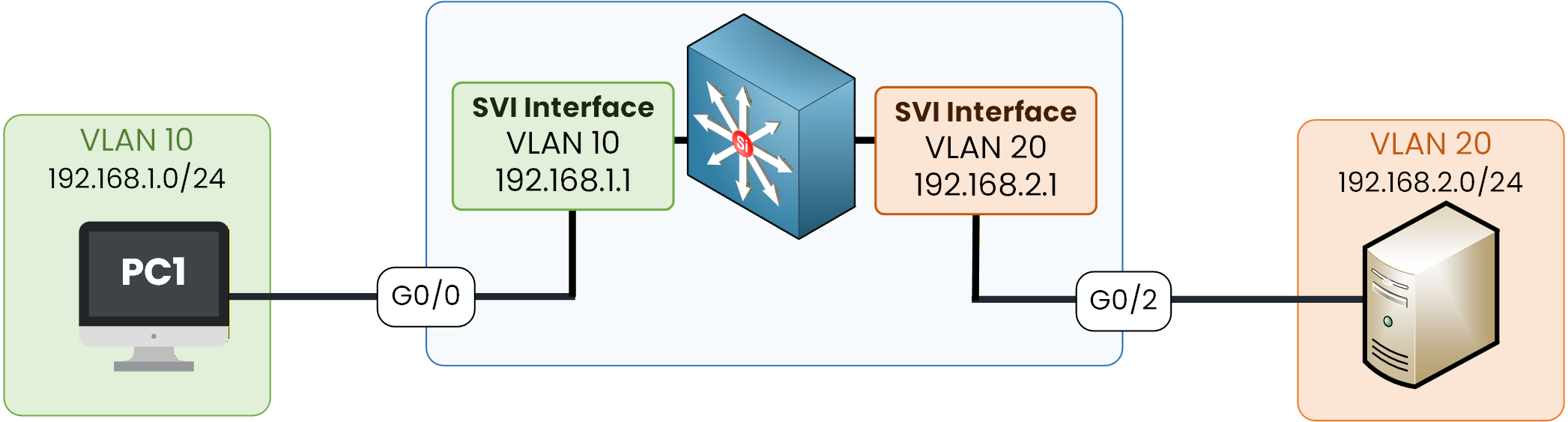
Figure 3 – SVI routing topology
Step 1 — Create VLANs on the Layer 3 Switch
We start by creating the VLANs on the Layer 3 switch:
L3# configure terminal
Enter configuration commands, one per line.  End with CNTL/Z.
L3(config)# vlan 10
L3(config-vlan)# name Sales
L3(config-vlan)# exit

L3(config)# vlan 20
L3(config-vlan)# name Tech
Step 2 — Assign Access Ports to VLANs
Each connected device must be placed in the correct VLAN.
40 % Complete: you’re making great progress
Unlock the rest of this lesson
If you’d like to continue your CCNA journey, simply create your free account.
Access all CCNA lessons
Practice with hands-on labs
Train with Practice exams and Quizzes
Progress tracking in your dashboard
Made by network engineers - CCNP certified
learners globally
SVI InterVLAN Routing
SVI InterVLAN Routing turns a Layer 3 switch into a device that handles both switching and routing for multiple VLANs. In this lesson, you will see why this method offers higher speed and scalability than older approaches.