CCNA Flashcards: 30 Free Cards With Answers, by Exam Topic
· 8 min read
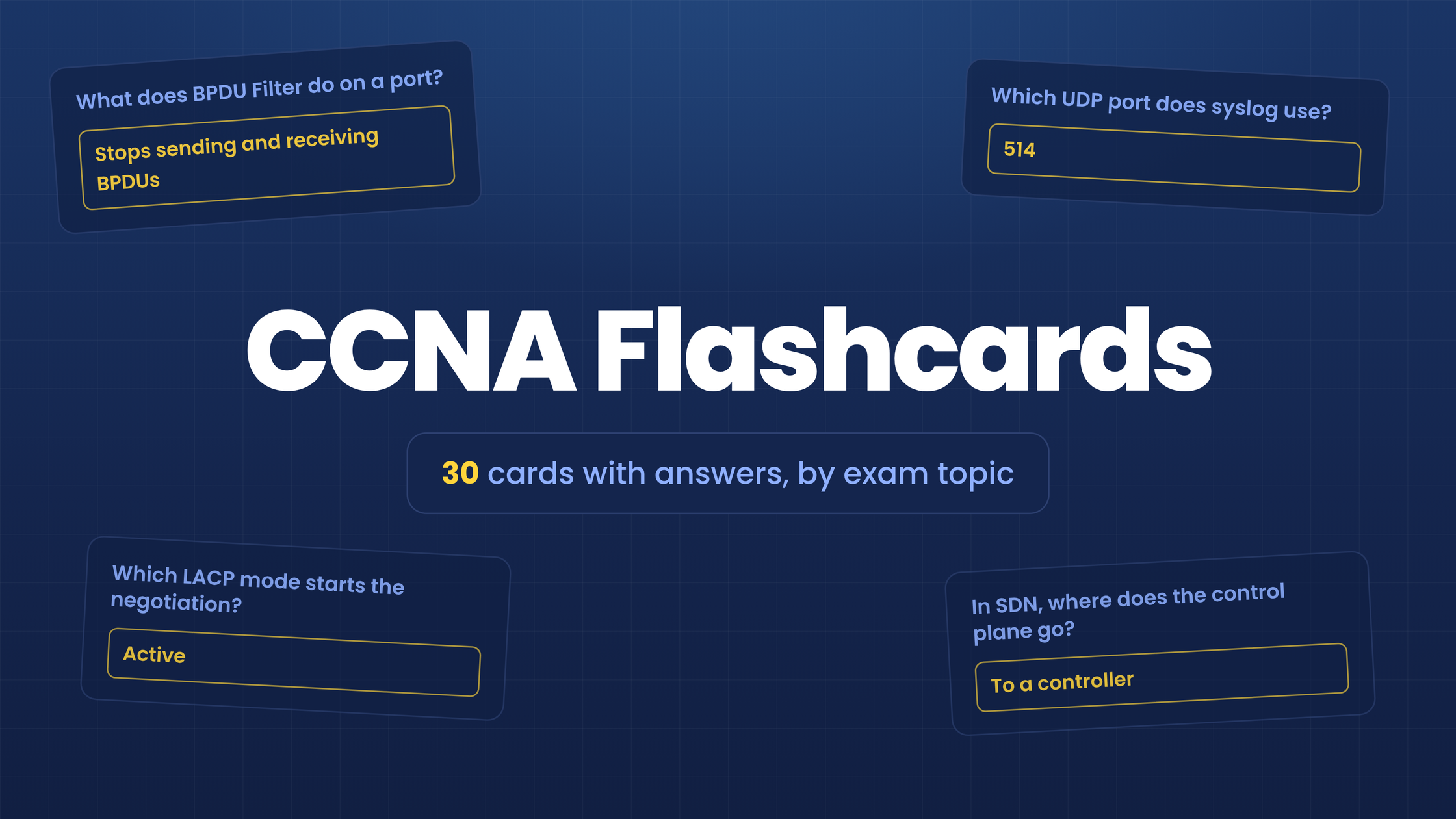
What does BPDU Filter do on a port?
38% of our learners get this flashcard wrong. It's the CCNA card they miss most.
From August to October 2026, we checked 115,237 answers from our 10,000+ learners.
Here are 30 of our CCNA flashcards, with the answers. 5 for each exam topic.
Our CCNA flashcards in 30 seconds
We made 700+ flashcards for the CCNA. They come with the lessons of our CCNA course. Each card is one question with 4 choices. You pick one, then you see the right answer and a short explanation.
The app plans your reviews. Cards you know come back in a few weeks, and cards you miss come back tomorrow. A daily review is quick: the one below is 12 cards in 3 minutes.
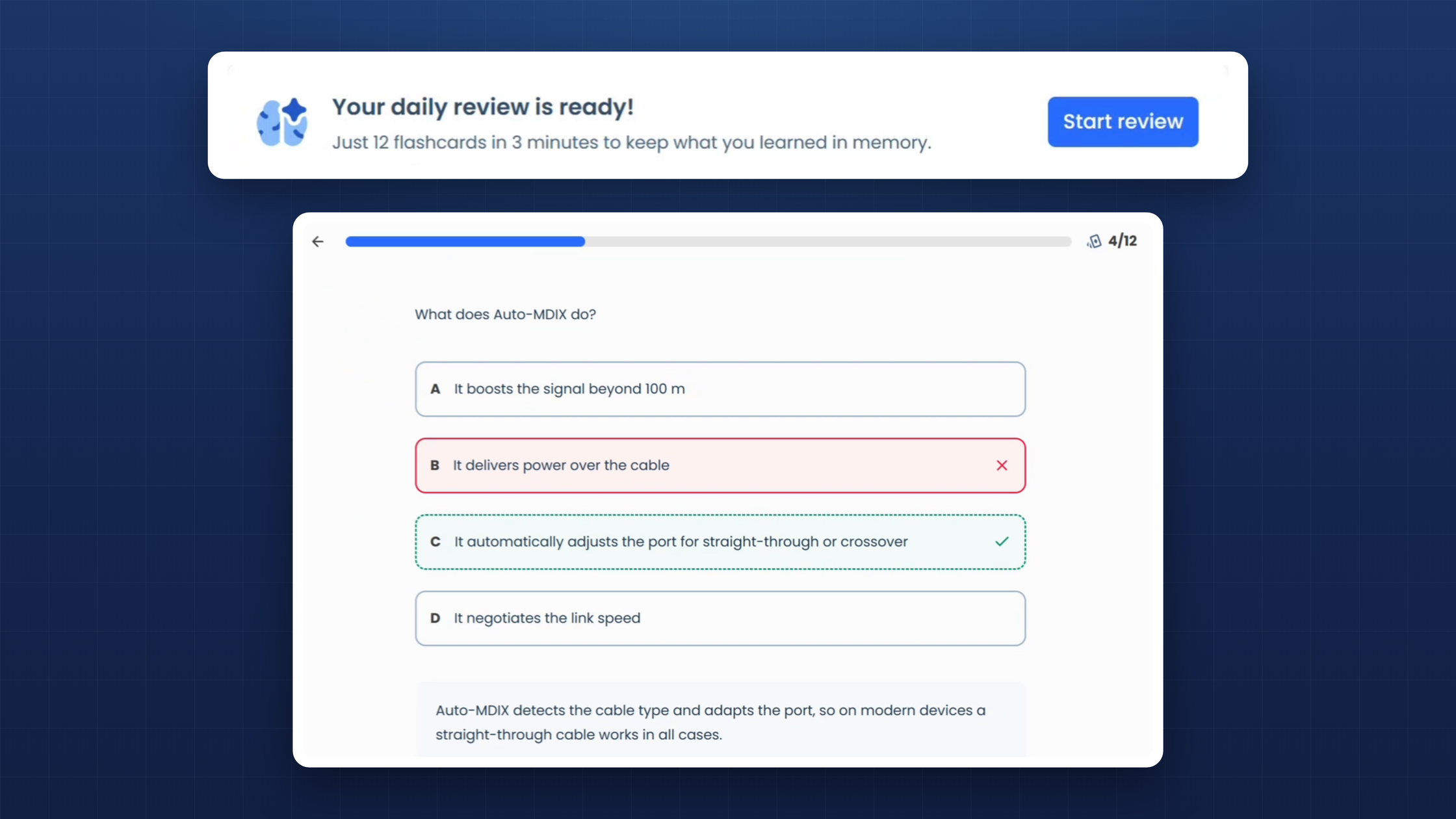
Figure 1 – Your daily review on PingMyNetwork, and a card with its explanation.
Why every day? We explain it in Best Way to Study for the CCNA.
What 115,237 answers tell us
Missing cards is normal. Our learners get about 1 in 4 wrong the first time they see them. When a card comes back in a later review, they still miss about 1 in 6. So one right answer doesn't mean you've got it for good.
Your memory of a card also fades with time. Our app estimates how much of each card you still remember. The chart below shows that the more a card has faded, the more often our learners miss it. That's why the app brings a card back before it fades too much.
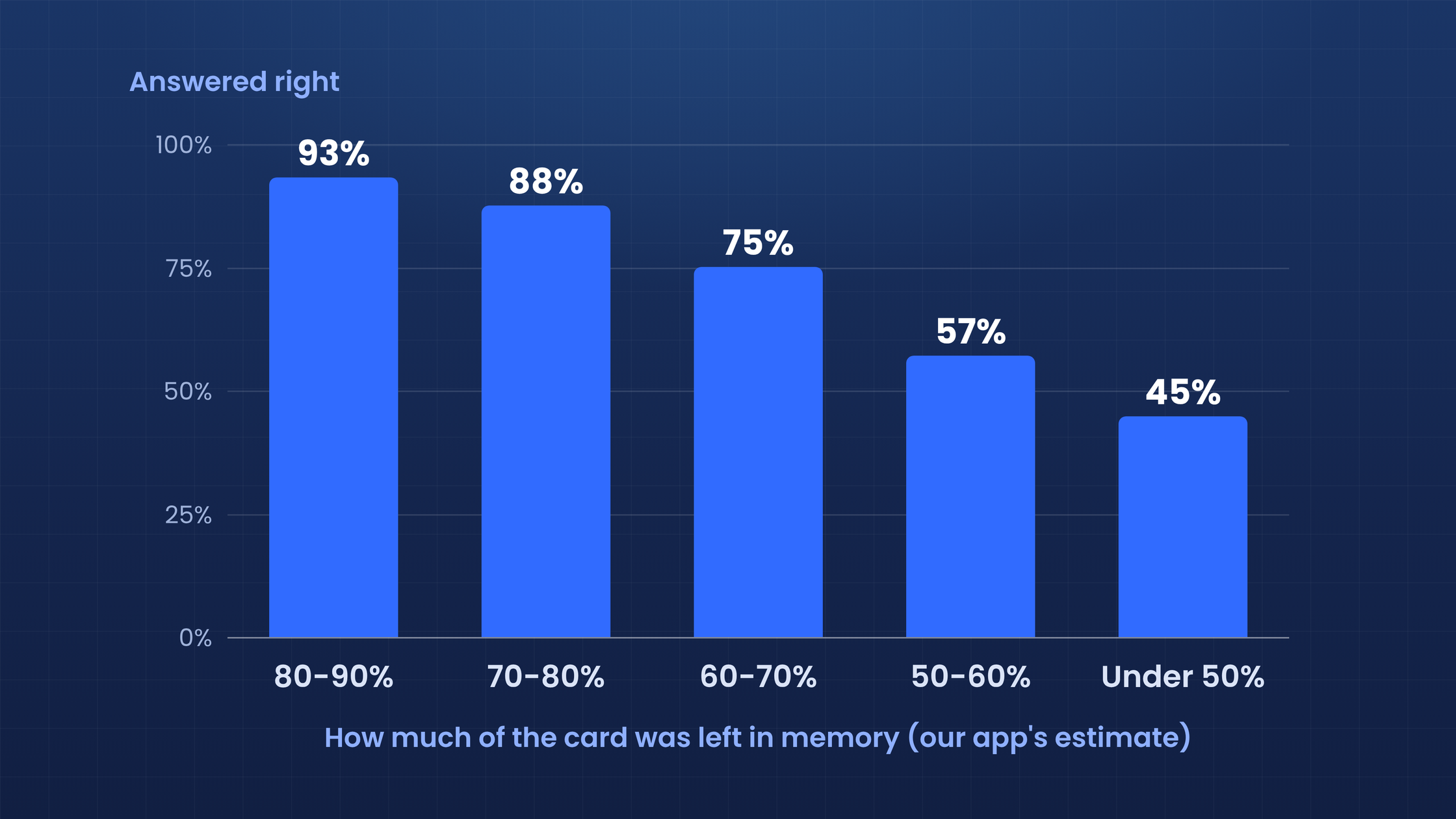
Figure 2 – How often our learners got a CCNA card right, by how much of it was left in memory. Reviews from August to October 2026.
The hardest topic is Spanning Tree: the 5 cards our learners miss most are all about it. The worst is the one we started with. The answer: BPDU Filter stops the port from sending and receiving BPDUs.
Its 3 wrong answers are what three look-alike tools do. BPDU Guard shuts the port down when a BPDU comes in. Root Guard stops a neighbour switch from becoming the root. PortFast lets the port skip the Listening and Learning states. So learn the four side by side, and for each one ask: what happens when a BPDU shows up?
30 CCNA flashcards, with answers
Each card has 4 choices, like in our app. Hide the Answer column, pick yours, then check.
Network Fundamentals
Network basics are 20% of the exam. These cards test the OSI layers, the IPv4 header, subnetting and IPv6.
Front of the card | Answer |
|---|---|
At Layer 4 (Transport), data is split into smaller units. What are they called? | C. Segments |
What does the IPv4 Header Checksum verify? | B. Only the IPv4 header |
What is the minimum size of an IPv4 header? | D. 20 bytes |
How many usable hosts does a /27 provide? | A. 30 |
Which multicast address reaches all IPv6 routers? | B. FF02::2 |
Network Access
Switching is another 20%: Spanning Tree, trunks, EtherChannel and VLAN tags.
Front of the card | Answer |
|---|---|
What is the default STP Forward Delay timer? | A. 15 seconds |
How many Designated Ports does each STP segment have? | B. Exactly one |
Two ports are both in dynamic auto mode. What happens? | A. The link stays in access mode |
Which LACP mode actively initiates the negotiation? | B. active |
How many bits does the 802.1Q tag reserve for the VLAN ID? | D. 12 |
IP Connectivity
Routing is the biggest part, at 25%. These cards test how a router picks a route, OSPF and static routes.
Front of the card | Answer |
|---|---|
What is Administrative Distance (AD)? | C. The trust level of a routing source |
What is the router's route-selection decision order? | D. LPM → AD → Metric → ECMP |
PC1 (192.168.1.1) wants to reach PC2 (192.168.2.1). What does PC1 do first? | C. It compares PC2's IP with its own subnet |
In what order does OSPF select its Router ID? | C. Manual, then highest loopback, then highest physical |
When does a floating static route appear in the routing table? | A. Only when the primary route disappears |
IP Services
Services like syslog, NAT and DHCP make up 10% of the exam.
Front of the card | Answer |
|---|---|
Which UDP port does Syslog use to send messages to a server? | D. 514 |
How are Syslog severity levels ordered? | A. 0 = Emergency, 7 = Debugging |
What does PAT add compared to Dynamic NAT? | B. It translates the source port too |
What are the four steps of the DHCP process (DORA)? | D. Discover, Offer, Request, Acknowledge |
Which UDP ports do the DHCP client and server use? | B. UDP 68 for the client, UDP 67 for the server |
Security Fundamentals
Security is 15%: port security, DHCP snooping and Wi-Fi.
Front of the card | Answer |
|---|---|
What is the default Port Security violation mode? | C. |
What does Restrict mode do that Protect mode does not? | D. Logs each violation and counts it |
On an untrusted port, which DHCP messages are blocked? | B. OFFER, ACK and NAK |
Which authentication method does WPA3 Personal use? | A. SAE |
Which encryption algorithm does WEP use? | B. RC4 |
Automation and Programmability
The last 10% is automation: SDN, REST APIs and JSON.
Front of the card | Answer |
|---|---|
In SDN, what happens to the control plane? | C. It moves to a controller |
What does the northbound API connect? | A. Applications to the controller |
Which HTTP method creates a new resource? | B. POST |
What does HTTP status code 401 mean? | D. Missing credentials |
In JSON, what do curly braces define? | B. An object |
Get all 700+ cards
These 30 cards come from our CCNA course. You get the other 670+ with the lessons, and the app brings them back in your daily review. You can try PingMyNetwork for free.
 Written by Dorian AlaryPingMyNetwork co-founderCCNA 200-301Developper


