Discover how VRRP handles recovering routers and how VRRPv3 brings native IPv6 support.
Here is a major difference from HSRP: preemption is enabled by default in VRRP.Preemption by Default
Suppose R1 boots back up with its priority still at 110.
Will it take the Master role back?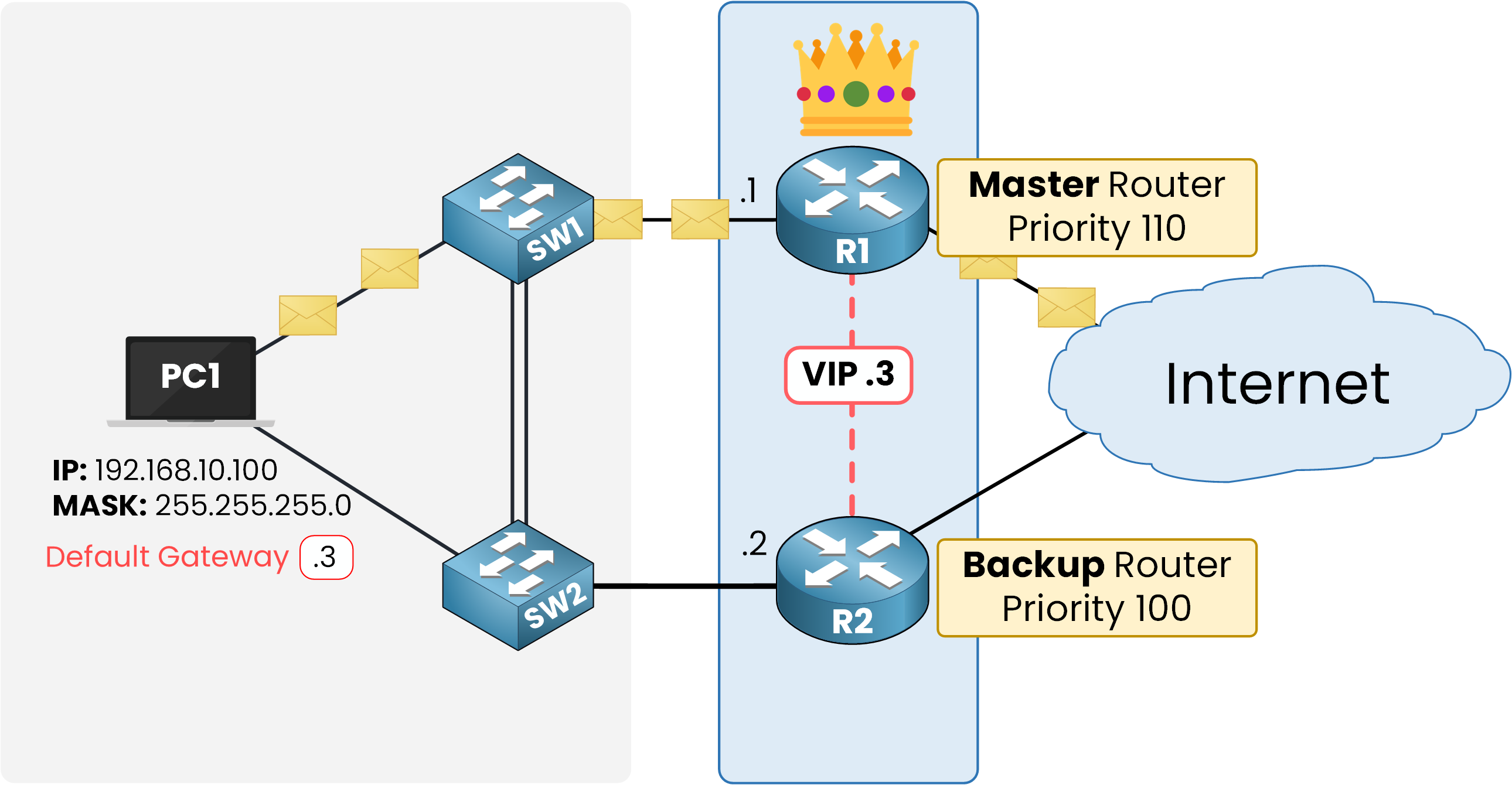
Figure 9 – R1 reclaims the Master role
Yes, immediately, without any extra configuration.
As soon as R2 hears an Advertisement with a higher priority than its own, it steps straight down to Backup.
R1 then moves through its own election and becomes Master again.R2# %VRRP-6-STATECHANGE: GigabitEthernet0/0 Grp 1 state Master -> BackupR1# %VRRP-6-STATECHANGE: GigabitEthernet0/0 Grp 1 state Init -> Backup %VRRP-6-STATECHANGE: GigabitEthernet0/0 Grp 1 state Backup -> MasterThis instant takeover is built into the base protocol, unlike HSRP where preempt starts disabled and must be turned on.
Answer the question below
Click on "Complete" to continue
You can still disable it if a slow, controlled takeover is what your design needs:
R1# conf t
Enter configuration commands, one per line.  End with CNTL/Z.
R1(config)# int g0/0
R1(config-if)# no vrrp 1 preempt
R1(config-if)# end
Disabling preemption avoids flapping when a recovering router's priority is unstable, for example right after a reboot.
The cost: you stay on a lower-priority Master until the next real failure.Answer the question below
Is preemption enabled or disabled by default in VRRP?
Answer the question below
RA (100) is Master; RB (110) and RC (120, no preempt) then join: which router ends up Master?
Like HSRP, VRRP comes in two versions.
VRRPv2
VRRPv2 is defined in RFC 3768, IPv4 only.
It supports groups numbered 0 to 255, and Cisco's MD5 extension runs on top of it for authentication.VRRPv3
VRRPv3 is defined in RFC 5798, and adds IPv6 support.
It also drops authentication completely, so an MD5 or plaintext key from VRRPv2 won't work here.VRRPv2
VRRPv3
IP Support
IPv4 only
IPv4 and IPv6
Native Timer Precision
Whole seconds
Centiseconds
Authentication
Cisco MD5 extension available
Not supported
Cisco IOS Configuration
vrrp <group> directly under the interface
fhrp version vrrp v3, then vrrp <group> under the interface
Table 1 – VRRPv2 vs VRRPv3 comparison
Migrating a running VRRPv2 group to v3 still starts with that global
fhrp version vrrp v3command on every router in the group.
A version mismatch breaks the election, just like it does in HSRP.Theory complete. Let's build and test a full VRRP configuration on the Cisco CLI.
Answer the question below
Which VRRP version supports IPv6?