This lesson continues from the multi-area topology built in OSPFv3 Configuration: R1 and R2 in Area 0, R2 and R3 in Area 1, all adjacencies FULL.
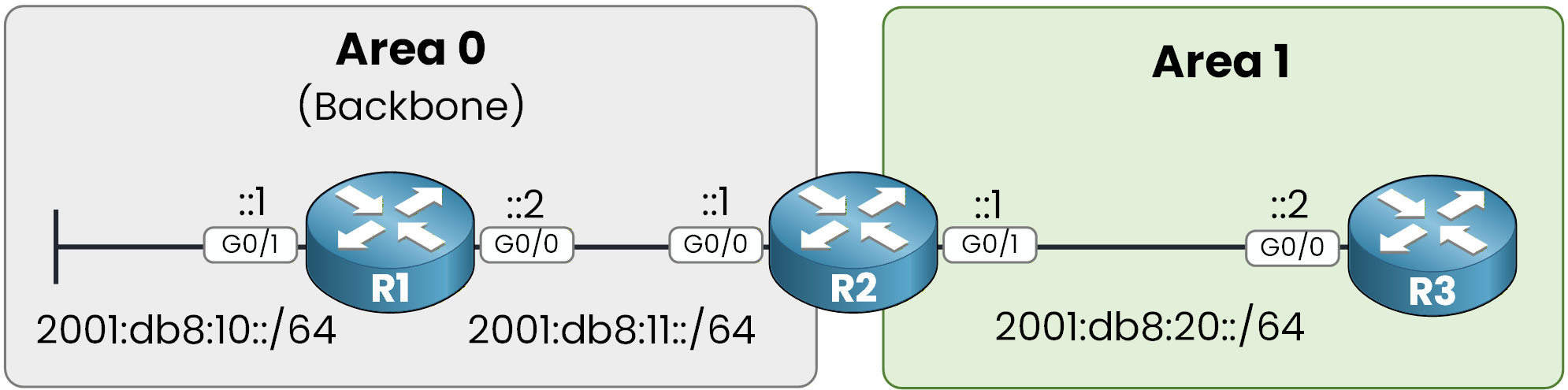
Figure 1 - OSPFv3 multi-area topology
You can also configure a passive interface in OSPFv3.
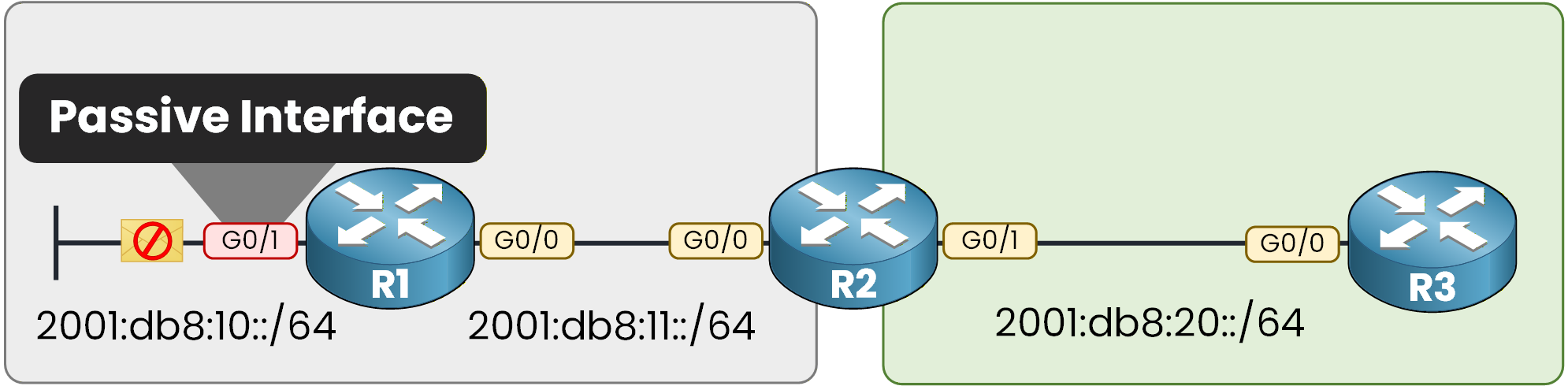
Figure 2 - OSPFv3 Passive Interface
If you remember the concept, a passive interface suppresses OSPF Hello messages on a specific interface.
This means:
The interface still advertises its network
But it does not form neighbor adjacencies
Configure a Passive Interface (Per Interface)
You can configure a passive interface directly under the OSPFv3 process.
On R1:
R1# conf t
Enter configuration commands, one per line.  End with CNTL/Z.
R1(config)# router ospfv3 1
R1(config-router)# passive-interface g0/1
Now verify:
R1# show ospfv3 interface g0/1
GigabitEthernet0/1 is up, line protocol is up
  Link Local Address FE80::52CA:C4FF:FE00:1201, Interface ID 3
  Area 0, Process ID 1, Instance ID 0, Router ID 1.1.1.1
  Network Type BROADCAST, Cost: 1
  Transmit Delay is 1 sec, State WAITING, Priority 1
  No designated router on this network
  No backup designated router on this network
  Timer intervals configured, Hello 10, Dead 40, Wait 40, Retransmit 5
    No Hellos (Passive interface)
    Wait time before Designated router selection 00:00:09
  Graceful restart helper support enabled
  Index 1/1/1, flood queue length 0
  Next 0x0(0)/0x0(0)/0x0(0)
  Last flood scan length is 0, maximum is 0
  Last flood scan time is 0 msec, maximum is 1 msec
  Neighbor Count is 0, Adjacent neighbor count is 0
  Suppress hello for 0 neighbor(s)
This confirms:
The interface is no longer sending Hello packets
No adjacency can form on this interface
The network is still advertised, but no neighbors are allowed.
Configure Passive by Default
You can also make all interfaces passive by default, then selectively enable the ones that must form adjacencies.
On R3:
R3# conf t
Enter configuration commands, one per line.  End with CNTL/Z.
R3(config)# router ospfv3 1
R3(config-router)# passive-interface default
%OSPFv3-5-ADJCHG: Process 1, IPv6, Nbr 2.2.2.2 on GigabitEthernet0/0 from FULL to DOWN, Neighbor Down: Interface down or detached
Immediately, the adjacency drops!
This happens because the interface is now passive and stops sending Hellos.
Now re-enable OSPF on the required interface:R3(config-router)# no passive-interface g0/0 %OSPFv3-5-ADJCHG: Process 1, IPv6, Nbr 2.2.2.2 on GigabitEthernet0/0 from LOADING to FULL, Loading DoneThe adjacency returns to FULL.
40 % Complete: you’re making great progress
Ready to pass your CCNP exam?