In the previous lesson, locally originated routes and the shortest AS-PATH settled the choice. When those tie too, BGP reads the Origin code.
After Weight, Local Preference, locally originated routes, and AS-PATH length, BGP evaluates the next attribute:
Lowest Origin code wins.
The Origin attribute tells BGP how a prefix entered the BGP table in the first place. When all higher attributes are equal, Origin becomes the tiebreaker.
What is Origin?
Origin is a well-known mandatory attribute carried in every BGP update.
It can take only three values: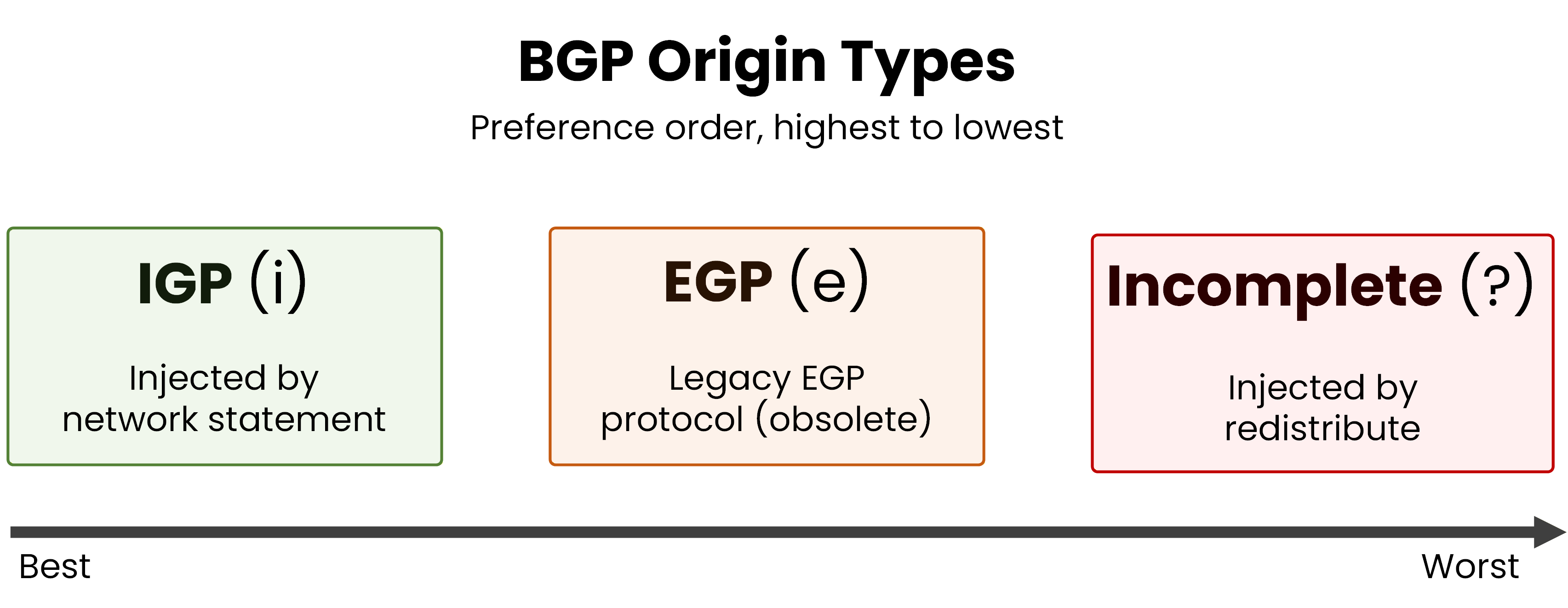
Figure 1 – BGP Origin Types
IGP (i) — The prefix was injected into BGP using a network statement.
EGP (e) — The prefix came from the legacy EGP protocol. You will almost never see this in production.
Incomplete (?) — The prefix was injected through redistribution from another protocol (OSPF, EIGRP, static, connected).
When BGP compares two paths with the same Weight, Local Preference, Originate, and AS-PATH, it picks the one with the lowest Origin code:
R1# show bgp ipv4 unicast
BGP table version is 5, local router ID is 10.0.23.1
Status codes: s suppressed, d damped, h history, * valid, > best, i - internal,
              r RIB-failure, S Stale, m multipath, b backup-path, f RT-Filter,
              x best-external, a additional-path, c RIB-compressed,
              t secondary path,
Origin codes: i - IGP, e - EGP, ? - incomplete
RPKI validation codes: V valid, I invalid, N Not found

     Network          Next Hop            Metric LocPrf Weight Path
 *>  10.0.34.0/30     10.0.23.2                0             0 300 i
 * i 10.0.34.0/30     10.0.24.2                0    100      0 300 ?
IGP (i) is preferred over EGP (e), which is preferred over Incomplete (?).
You read the Origin in the last column of the BGP table, right after the AS-PATH.Answer the question below
A prefix injected into BGP with the redistribute command has which Origin code?
The Scenario
The topology below reuses the same setup as the AS-PATH lesson, with one critical difference in how each side advertises the prefix 10.0.34.0/30.
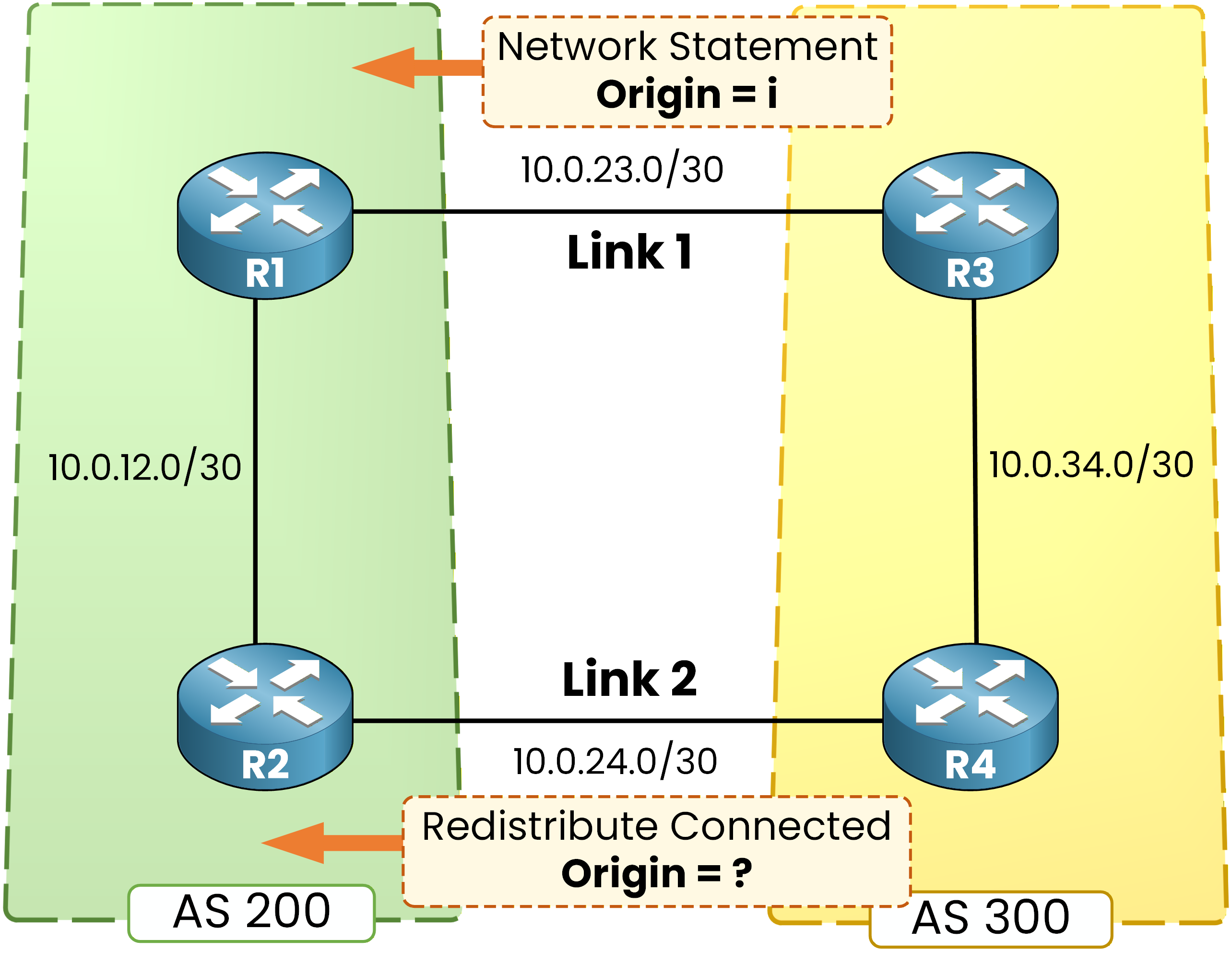
Figure 2 – Two paths with different Origin types
R3 advertises the prefix toward R1 using a
networkstatement, so the prefix arrives with Origin i.
R4 advertises the same prefix toward R2 usingredistribute connected, so the prefix arrives with Origin ?.From R1's point of view, both paths share:
Equal Weight (
0)Equal Local Preference (
100)Equal AS-PATH (
300, length 1)
The only attribute that differs is the Origin.
Verifying the Result
Check the BGP table on R1:
R1# show bgp ipv4 unicast
BGP table version is 5, local router ID is 10.0.23.1
Status codes: s suppressed, d damped, h history, * valid, > best, i - internal,
              r RIB-failure, S Stale, m multipath, b backup-path, f RT-Filter,
              x best-external, a additional-path, c RIB-compressed,
              t secondary path,
Origin codes: i - IGP, e - EGP, ? - incomplete
RPKI validation codes: V valid, I invalid, N Not found

     Network          Next Hop            Metric LocPrf Weight Path
 *>  10.0.34.0/30     10.0.23.2                0             0 300 i
 * i 10.0.34.0/30     10.0.24.2                0    100      0 300 ?
Two paths exist for 10.0.34.0/30:
The eBGP path via R3 carries Origin i (IGP)
The iBGP path via R2 carries Origin ? (Incomplete)
The best-path marker
*>is on the path with Origin i, because IGP is preferred over Incomplete when every higher attribute is equal.40 % Complete: you’re making great progress
Ready to pass your CCNP exam?