Storing hundreds of external routes on an edge router with a single path out consumes CPU and RAM for zero operational gain.
Converting Area 2 into a Stub Area eliminates this unnecessary control plane overhead.The Lab Topology
Look at the layout:
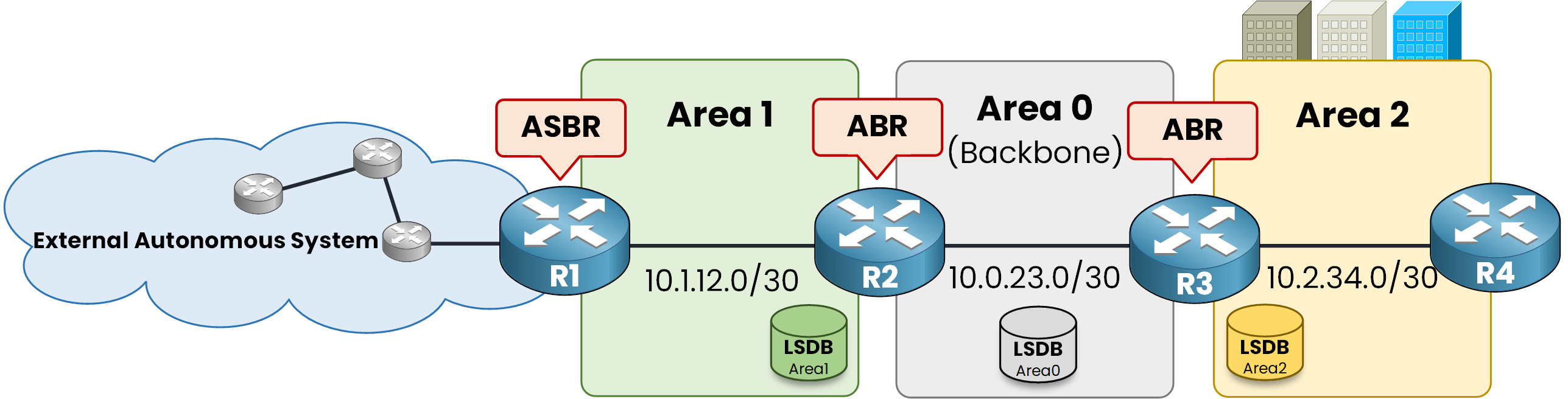
Figure 1 – The lab topology
R2 and R3 act as Area Border Routers (ABRs).
R4 sits at the edge of Area 2 as a single-homed branch router.
Creating External Routes
R1 connects to the external autonomous system and learns 204 networks in the
172.16.0.0/16range via eBGP.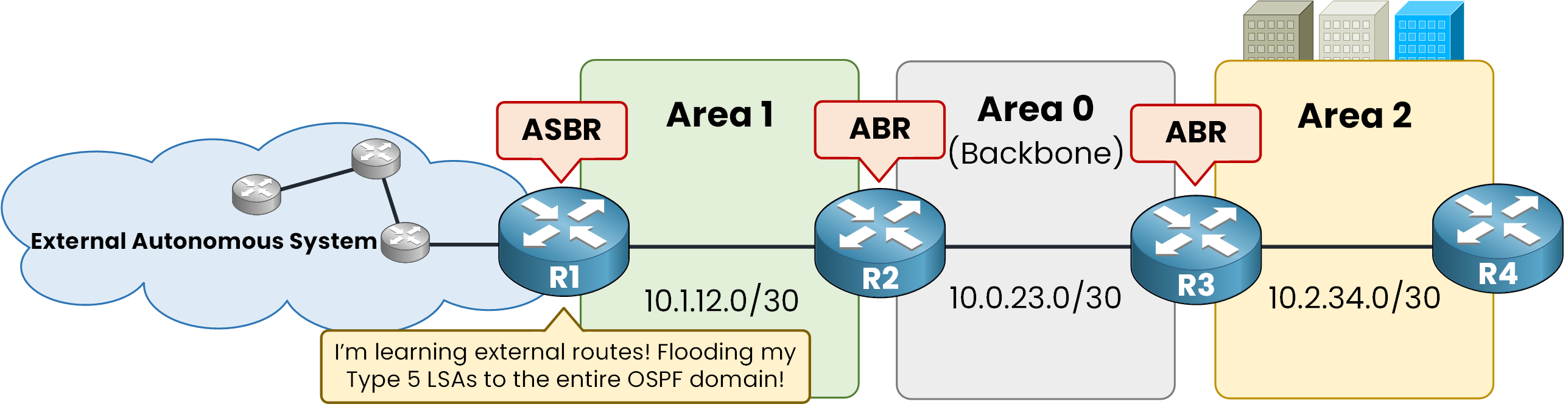
Figure 2 – R1 becomes an ASBR
Redistributing BGP into OSPF turns R1 into an ASBR.
It generates a Type 5 LSA for every external network:R1# configure terminal R1(config)# router ospf 1 R1(config-router)# redistribute bgp 65000 subnets R1(config-router)# endBy default, every router across all areas receives these 204 Type 5 LSAs and populates its routing table with individual external entries.
Answer the question below
Which LSA type does R1 generate for the redistributed networks?
By default, Type 5 LSAs flood uninhibited across standard area boundaries down to edge routers.
The ABR Relay Path
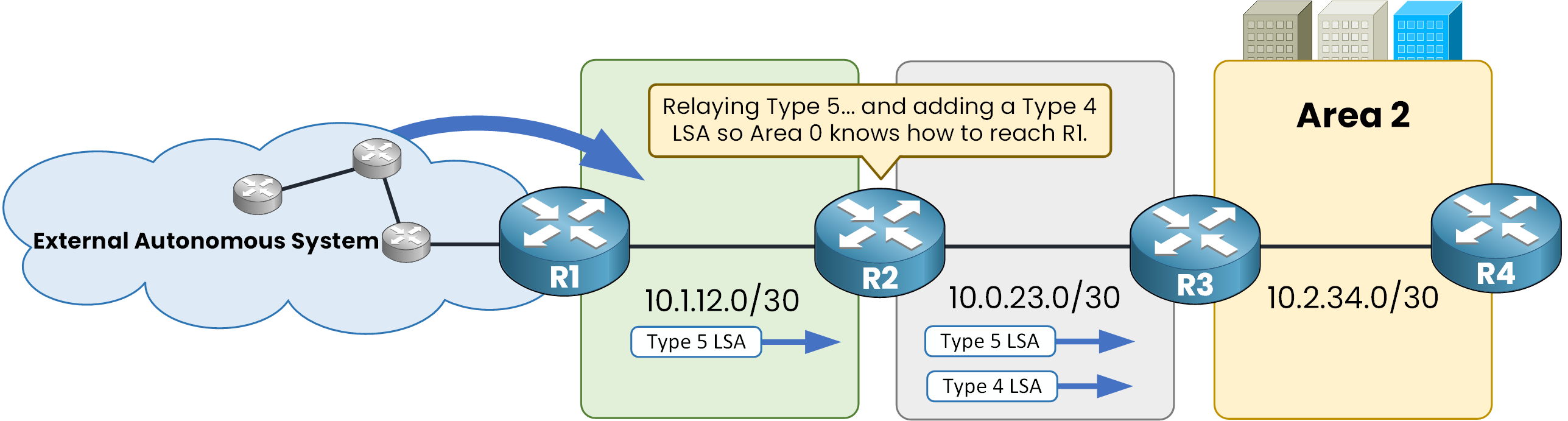
Figure 3 – The ABRs relay the LSAs
R2 forwards the Type 5 LSAs into Area 0 and originates a Type 4 LSA to advertise reachability to R1 (the ASBR).
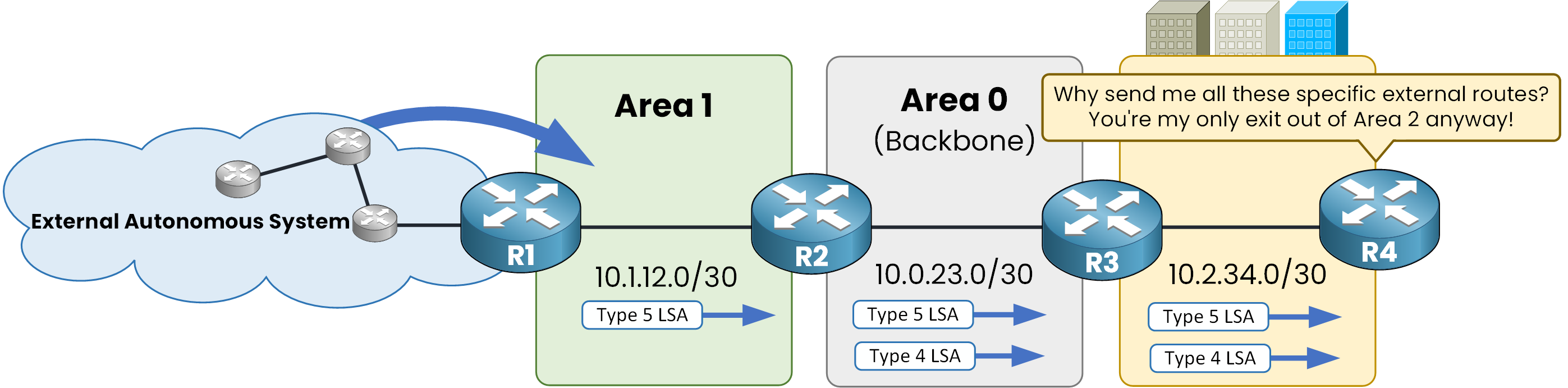
Figure 4 – R4 receives routes it does not need
R3 repeats this process at the Area 2 border.
Because standard areas perform no filtering, every external LSA enters R4's Link-State Database (LSDB).Routing Table Overhead
Inspect the OSPF routing table on R4:
R4# show ip route ospf
Codes: L - local, C - connected, S - static, R - RIP, M - mobile, B - BGP
       D - EIGRP, EX - EIGRP external, O - OSPF, IA - OSPF inter area
       N1 - OSPF NSSA external type 1, N2 - OSPF NSSA external type 2
       E1 - OSPF external type 1, E2 - OSPF external type 2
       i - IS-IS, su - IS-IS summary, L1 - IS-IS level-1, L2 - IS-IS level-2
       ia - IS-IS inter area, * - candidate default, U - per-user static route
       o - ODR, P - periodic downloaded static route, H - NHRP, l - LISP
       + - replicated route, % - next hop override

Gateway of last resort is not set

      1.0.0.0/32 is subnetted, 1 subnets
O IA     1.1.1.1 [110/4] via 10.2.34.1, 00:05:31, GigabitEthernet0/0
      2.0.0.0/32 is subnetted, 1 subnets
O IA     2.2.2.2 [110/3] via 10.2.34.1, 00:05:31, GigabitEthernet0/0
      3.0.0.0/32 is subnetted, 1 subnets
O IA     3.3.3.3 [110/2] via 10.2.34.1, 00:05:41, GigabitEthernet0/0
      10.0.0.0/8 is variably subnetted, 4 subnets, 2 masks
O IA     10.0.23.0/30 [110/2] via 10.2.34.1, 00:05:41, GigabitEthernet0/0
O IA     10.1.12.0/30 [110/3] via 10.2.34.1, 00:05:31, GigabitEthernet0/0
      172.16.0.0/24 is subnetted, 204 subnets
O E2     172.16.1.0 [110/20] via 10.2.34.1, 00:04:58, GigabitEthernet0/0
O E2     172.16.2.0 [110/20] via 10.2.34.1, 00:04:58, GigabitEthernet0/0
O E2     172.16.5.0 [110/20] via 10.2.34.1, 00:04:58, GigabitEthernet0/0
O E2     172.16.8.0 [110/20] via 10.2.34.1, 00:04:58, GigabitEthernet0/0
O E2     172.16.9.0 [110/20] via 10.2.34.1, 00:04:57, GigabitEthernet0/0
O E2     172.16.12.0 [110/20] via 10.2.34.1, 00:04:57, GigabitEthernet0/0
O E2     172.16.14.0 [110/20] via 10.2.34.1, 00:04:57, GigabitEthernet0/0
O E2     172.16.20.0 [110/20] via 10.2.34.1, 00:04:57, GigabitEthernet0/0
 --More--
R4 holds 204 individual
O E2prefixes. Every route points to 10.2.34.1 (R3) as its next-hop.Storing granular external topologies on a router with a single exit interface wastes control plane resources when all outbound traffic takes the exact same physical path.
Answer the question below
Which next hop does R4 use for every OSPF route?
In a Stub Area, the ABR blocks Type 4 and Type 5 LSAs at the boundary and injects a single default route (
0.0.0.0/0) instead.Keep these two architectural rules in mind:
No ASBR allowed: A stub area cannot contain an autonomous system boundary router.
Backbone protection: Area 0 can never be configured as a stub area.
Declaring the Stub on the ABR
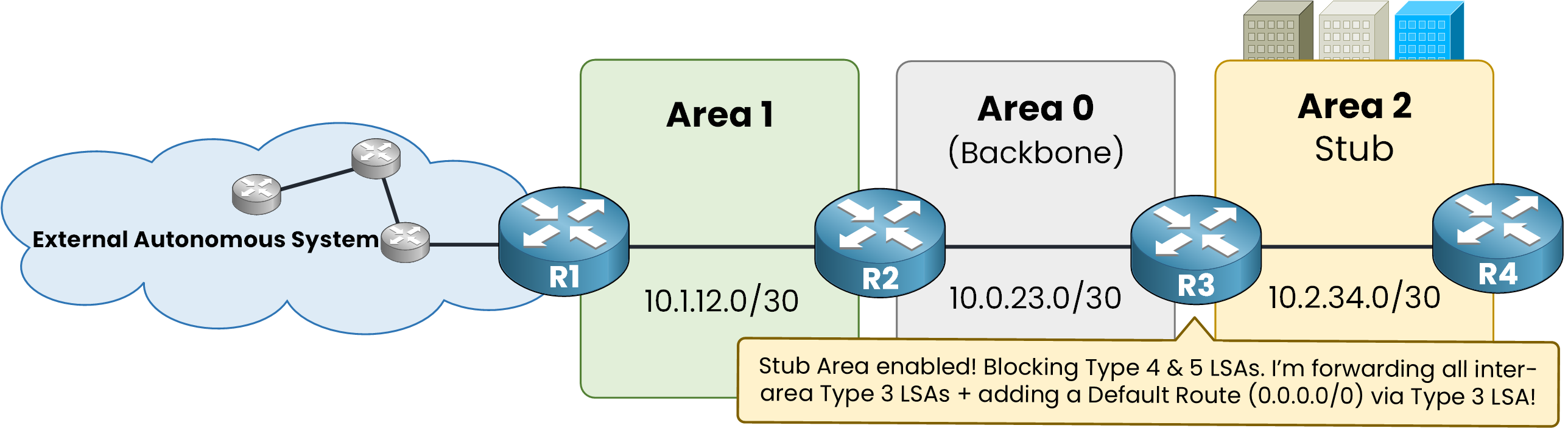
Figure 5 – Area 2 is now a stub area
On R3 (the ABR), apply the
area stubcommand to stop propagating Type 5 LSAs into Area 2.
Without external routes entering the area, Type 4 LSAs become useless and are dropped as well:R3# configure terminal R3(config)# router ospf 1 R3(config-router)# area 2 stub %OSPF-5-ADJCHG: Process 1, Nbr 4.4.4.4 on GigabitEthernet0/1 from FULL to DOWN, Neighbor Down: Adjacency forced to reset R3(config-router)# endImmediately after entering the command, the neighbor adjacency drops.
R3 now sets the Stub flag in its Hello packets. Because R4 does not advertise this flag yet, an area option mismatch breaks the relationship.Declaring the Stub on the Internal Router
To restore the adjacency, match the configuration on R4:
R4# configure terminal
R4(config)# router ospf 1
R4(config-router)# area 2 stub
%OSPF-5-ADJCHG: Process 1, Nbr 3.3.3.3 on GigabitEthernet0/0 from LOADING to FULL, Loading Done
R4(config-router)# end
The console confirms the neighbor relationship returns to FULL:
Every router inside the area must agree on the stub flag, otherwise neighbor adjacencies remain permanently down.Answer the question below
In which state is the R3 to R4 adjacency once both routers are configured?
Check the OSPF routing table on R4 to verify the removal of external prefixes.
The Default Route Arrives
Run
show ip route ospfon R4:R4# show ip route ospf Codes: L - local, C - connected, S - static, R - RIP, M - mobile, B - BGP D - EIGRP, EX - EIGRP external, O - OSPF, IA - OSPF inter area N1 - OSPF NSSA external type 1, N2 - OSPF NSSA external type 2 E1 - OSPF external type 1, E2 - OSPF external type 2 i - IS-IS, su - IS-IS summary, L1 - IS-IS level-1, L2 - IS-IS level-2 ia - IS-IS inter area, * - candidate default, U - per-user static route o - ODR, P - periodic downloaded static route, H - NHRP, l - LISP + - replicated route, % - next hop override Gateway of last resort is 10.2.34.1 to network 0.0.0.0 O*IA 0.0.0.0/0 [110/2] via 10.2.34.1, 00:00:48, GigabitEthernet0/0 1.0.0.0/32 is subnetted, 1 subnets O IA 1.1.1.1 [110/4] via 10.2.34.1, 00:00:48, GigabitEthernet0/0 2.0.0.0/32 is subnetted, 1 subnets O IA 2.2.2.2 [110/3] via 10.2.34.1, 00:00:48, GigabitEthernet0/0 3.0.0.0/32 is subnetted, 1 subnets O IA 3.3.3.3 [110/2] via 10.2.34.1, 00:00:48, GigabitEthernet0/0 10.0.0.0/8 is variably subnetted, 4 subnets, 2 masks O IA 10.0.23.0/30 [110/2] via 10.2.34.1, 00:00:48, GigabitEthernet0/0 O IA 10.1.12.0/30 [110/3] via 10.2.34.1, 00:00:48, GigabitEthernet0/0All 204 external routes are replaced by a single
O*IA 0.0.0.0/0default route.
TheO*IAflag indicates that R3 injected this default path as a Type 3 Summary LSA.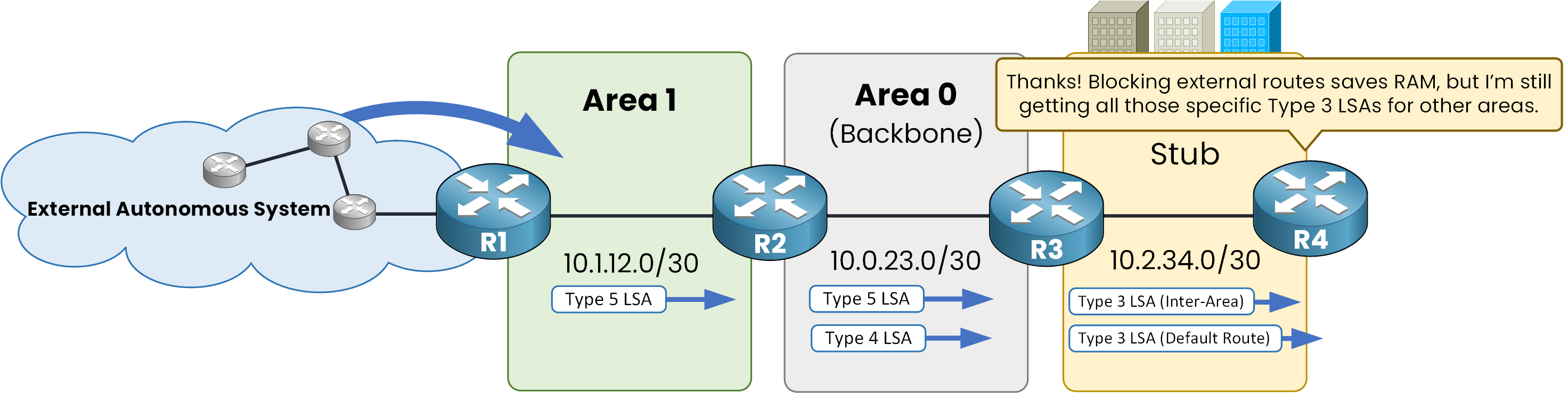
Figure 6 – A single Type 3 default route replaces the external LSAs
Inter-area routes (
O IA) remain because standard Stub Areas do not filter Type 3 LSAs.
Area 0 and Area 1 retain all 204 Type 5 LSAs, as stub restrictions apply strictly within Area 2.Confirming the Area Type
Verify the active area status directly on R4:
R4# show ip ospf | begin Area 2

    Area 2
        Number of interfaces in this area is 2
        It is a stub area
        Area has no authentication
        SPF algorithm last executed 00:01:02.448 ago
        SPF algorithm executed 6 times
        Area ranges are
        Number of LSA 9. Checksum Sum 0x0392C4
        Flood list length 0
R4 maintains complete reachability while stripping out external LSA overhead.
To filter out inter-area routes (O IA) in addition to external routes, convert the area into a Totally Stubby Area, right after the lab.Answer the question below
Which single word in the show ip ospf output confirms the area type?