A standard stub area assumes that no external routes originate behind its internal routers.
If an internal router connects to an external network, this assumption fails.Connecting an External Network to R4
R4 connects to an external network on
192.168.4.0/24via GigabitEthernet0/1.
Because this subnet runs outside OSPF, R4 must redistribute it so the rest of the domain (R1, R2, R3) can reach it.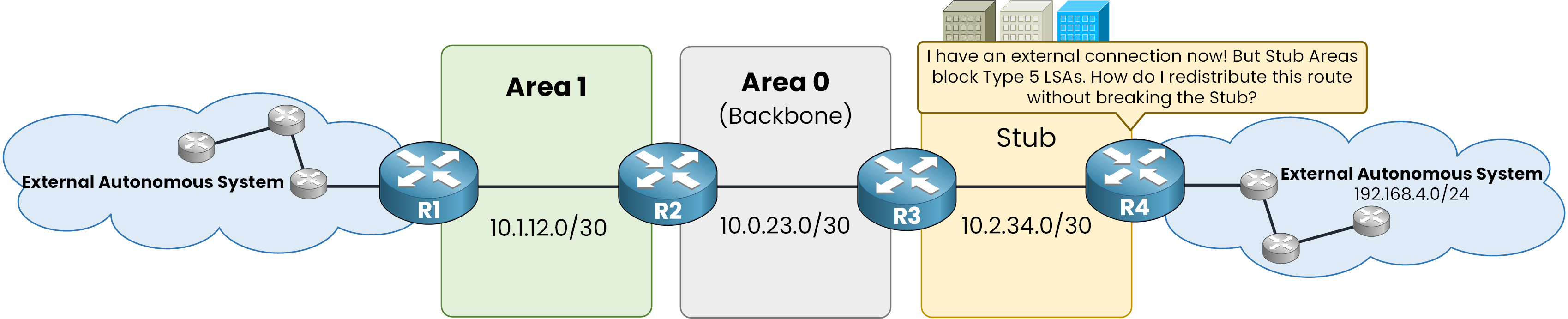
Figure 1 - R4 now connects to an external network of its own
Why Type 5 LSAs Are Blocked
Redistribute the connected network on R4:
R4# configure terminal
R4(config)# router ospf 1
R4(config-router)# redistribute connected subnets
R4(config-router)# end
Cisco IOS accepts the command without errors.
Check the external database on R4:R4# show ip ospf database external OSPF Router with ID (4.4.4.4) (Process ID 1)The database remains empty.
A stub area strictly forbids Type 5 LSAs, even when generated locally. R4 operates as an ASBR, but because Area 2 is configured as a stub, it cannot originate or flood a Type 5 LSA into the area.
Answer the question below
Which LSA type can a stub area never carry, even when the ASBR sits inside it?
A Not-So-Stubby Area (NSSA) solves the ASBR limitation. It blocks incoming Type 5 LSAs from entering the area, but allows internal routers to redistribute external routes using Type 7 LSAs (NSSA External).
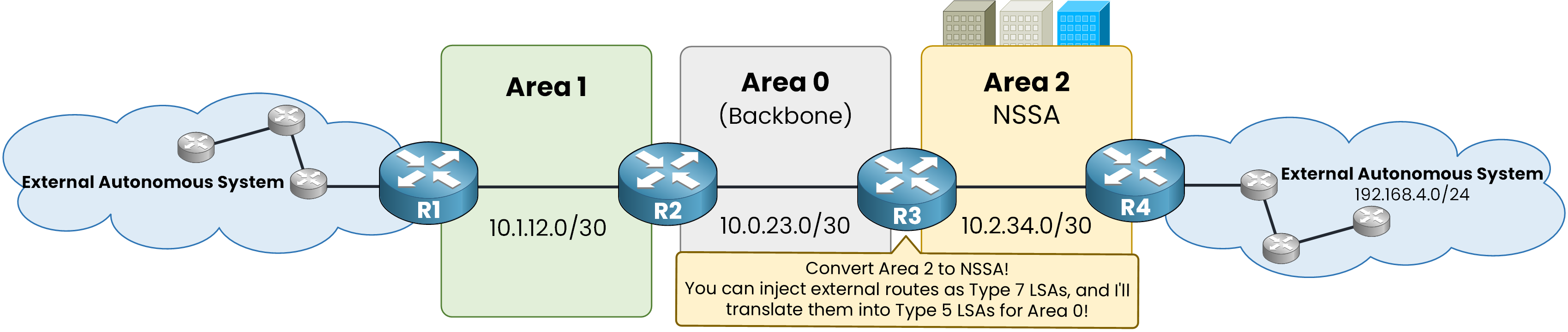
Figure 2 - Convert Area 2 to NSSA and let the Type 7 through
Changing the Area Type on R3
An OSPF area supports only one area type at a time.
Remove the stub configuration on R3 and declare Area 2 as an NSSA:R3# configure terminal R3(config)# router ospf 1 R3(config-router)# no area 2 stub no-summary R3(config-router)# area 2 nssa %OSPF-5-ADJCHG: Process 1, Nbr 4.4.4.4 on GigabitEthernet0/1 from FULL to DOWN, Neighbor Down: Adjacency forced to reset R3(config-router)# endThe OSPF adjacency drops immediately. Hello packets carry area option flags causing a mismatch between R3 and R4.
Updating the Area Type on R4
Apply the matching configuration on R4 to restore the adjacency:
R4# configure terminal
R4(config)# router ospf 1
R4(config-router)# no area 2 stub
R4(config-router)# area 2 nssa
%OSPF-5-ADJCHG: Process 1, Nbr 3.3.3.3 on GigabitEthernet0/0 from LOADING to FULL, Loading Done
R4(config-router)# end
Both routers now agree on the area parameters.
Check the NSSA database on R4:R4# show ip ospf database nssa-external OSPF Router with ID (4.4.4.4) (Process ID 1) Type-7 AS External Link States (Area 2) LS age: 62 Options: (No TOS-capability, Type 7/5 translation, DC) LS Type: AS External Link Link State ID: 192.168.4.0 (External Network Number) Advertising Router: 4.4.4.4 Network Mask: /24 Metric Type: 2 (Larger than any link state path) Metric: 20 Forward Address: 4.4.4.4 External Route Tag: 0R4 originates a Type 7 LSA for
192.168.4.0/24.The Forward Address (FA) field is set to
4.4.4.4(R4's loopback).
It tells routers outside Area 2 where to forward traffic for this external network.Answer the question below
Which LSA type does R4 generate for 192.168.4.0/24 inside the NSSA?
Type 7 LSAs never leave their originating NSSA.
The ABR translates Type 7 LSAs into Type 5 LSAs to reach the rest of the OSPF domain.Checking External Routes on R2
Check the routing table on R2 in Area 0:
R2# show ip route ospf
Codes: L - local, C - connected, S - static, R - RIP, M - mobile, B - BGP
       D - EIGRP, EX - EIGRP external, O - OSPF, IA - OSPF inter area
       N1 - OSPF NSSA external type 1, N2 - OSPF NSSA external type 2
       E1 - OSPF external type 1, E2 - OSPF external type 2
       i - IS-IS, su - IS-IS summary, L1 - IS-IS level-1, L2 - IS-IS level-2
       ia - IS-IS inter area, * - candidate default, U - per-user static route
       o - ODR, P - periodic downloaded static route, H - NHRP, l - LISP
       + - replicated route, % - next hop override

Gateway of last resort is not set

      1.0.0.0/32 is subnetted, 1 subnets
O        1.1.1.1 [110/2] via 10.1.12.1, 00:12:40, GigabitEthernet0/0
      3.0.0.0/32 is subnetted, 1 subnets
O        3.3.3.3 [110/2] via 10.0.23.2, 00:12:40, GigabitEthernet0/1
      4.0.0.0/32 is subnetted, 1 subnets
O IA     4.4.4.4 [110/3] via 10.0.23.2, 00:01:14, GigabitEthernet0/1
      10.0.0.0/8 is variably subnetted, 5 subnets, 2 masks
O IA     10.2.34.0/30 [110/2] via 10.0.23.2, 00:12:40, GigabitEthernet0/1
      172.16.0.0/24 is subnetted, 204 subnets
O E2     172.16.1.0 [110/20] via 10.1.12.1, 00:11:58, GigabitEthernet0/0
O E2     172.16.2.0 [110/20] via 10.1.12.1, 00:11:58, GigabitEthernet0/0
O E2     172.16.5.0 [110/20] via 10.1.12.1, 00:11:58, GigabitEthernet0/0
O E2     172.16.8.0 [110/20] via 10.1.12.1, 00:11:58, GigabitEthernet0/0
 --More--
O E2     192.168.4.0/24 [110/20] via 10.0.23.2, 00:01:14, GigabitEthernet0/1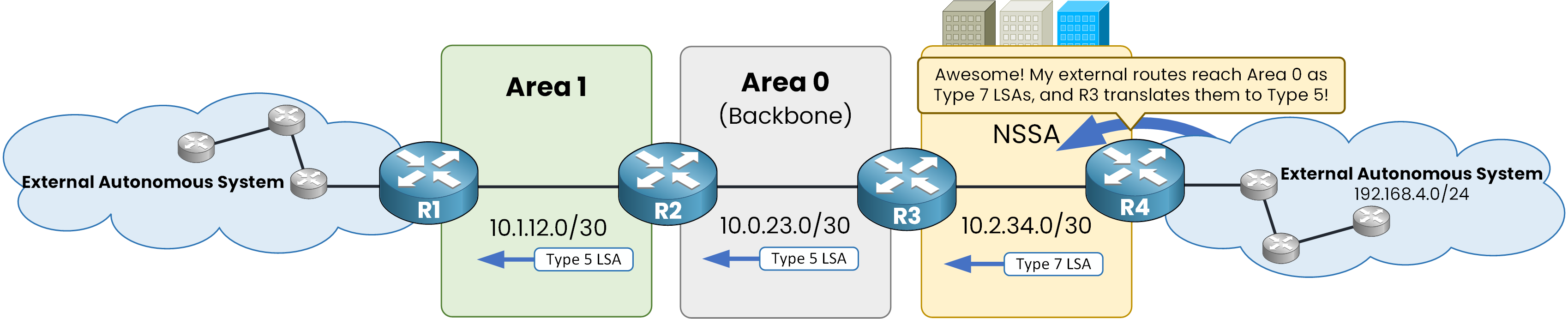
Figure 3 - R3 converts the Type 7 into a Type 5 at the area border
R2 sees
192.168.4.0/24as a standard external route (O E2).R3 (the ABR) automatically converted R4's Type 7 LSA into a standard Type 5 LSA before forwarding it into Area 0.
Routers in Area 0 learn the external network seamlessly, without knowing Area 2 is an NSSA.Injecting a Default Route into the NSSA
Check the OSPF routing table on R4:
R4# show ip route ospf
Codes: L - local, C - connected, S - static, R - RIP, M - mobile, B - BGP
       D - EIGRP, EX - EIGRP external, O - OSPF, IA - OSPF inter area
       N1 - OSPF NSSA external type 1, N2 - OSPF NSSA external type 2
       E1 - OSPF external type 1, E2 - OSPF external type 2
       i - IS-IS, su - IS-IS summary, L1 - IS-IS level-1, L2 - IS-IS level-2
       ia - IS-IS inter area, * - candidate default, U - per-user static route
       o - ODR, P - periodic downloaded static route, H - NHRP, l - LISP
       + - replicated route, % - next hop override

Gateway of last resort is not set

      1.0.0.0/32 is subnetted, 1 subnets
O IA     1.1.1.1 [110/4] via 10.2.34.1, 00:02:05, GigabitEthernet0/0
      2.0.0.0/32 is subnetted, 1 subnets
O IA     2.2.2.2 [110/3] via 10.2.34.1, 00:02:05, GigabitEthernet0/0
      3.0.0.0/32 is subnetted, 1 subnets
O IA     3.3.3.3 [110/2] via 10.2.34.1, 00:02:05, GigabitEthernet0/0
      10.0.0.0/8 is variably subnetted, 4 subnets, 2 masks
O IA     10.0.23.0/30 [110/2] via 10.2.34.1, 00:02:05, GigabitEthernet0/0
O IA     10.1.12.0/30 [110/3] via 10.2.34.1, 00:02:05, GigabitEthernet0/0
Unlike a standard Stub area, a standard NSSA accepts inter-area routes (
O IA) but does not inject a default route automatically.To give R4 a fallback path for reachability across the rest of the network, configure R3 to originate a default route into Area 2:
R3# configure terminal
R3(config)# router ospf 1
R3(config-router)# area 2 nssa default-information-originate
R3(config-router)# end
Verify the routing table on R4 again:
R4# show ip route ospf
Codes: L - local, C - connected, S - static, R - RIP, M - mobile, B - BGP
       D - EIGRP, EX - EIGRP external, O - OSPF, IA - OSPF inter area
       N1 - OSPF NSSA external type 1, N2 - OSPF NSSA external type 2
       E1 - OSPF external type 1, E2 - OSPF external type 2
       i - IS-IS, su - IS-IS summary, L1 - IS-IS level-1, L2 - IS-IS level-2
       ia - IS-IS inter area, * - candidate default, U - per-user static route
       o - ODR, P - periodic downloaded static route, H - NHRP, l - LISP
       + - replicated route, % - next hop override

Gateway of last resort is 10.2.34.1 to network 0.0.0.0

O*N2  0.0.0.0/0 [110/1] via 10.2.34.1, 00:00:22, GigabitEthernet0/0
      1.0.0.0/32 is subnetted, 1 subnets
O IA     1.1.1.1 [110/4] via 10.2.34.1, 00:02:51, GigabitEthernet0/0
      2.0.0.0/32 is subnetted, 1 subnets
O IA     2.2.2.2 [110/3] via 10.2.34.1, 00:02:51, GigabitEthernet0/0
      3.0.0.0/32 is subnetted, 1 subnets
O IA     3.3.3.3 [110/2] via 10.2.34.1, 00:02:51, GigabitEthernet0/0
      10.0.0.0/8 is variably subnetted, 4 subnets, 2 masks
O IA     10.0.23.0/30 [110/2] via 10.2.34.1, 00:02:51, GigabitEthernet0/0
O IA     10.1.12.0/30 [110/3] via 10.2.34.1, 00:02:51, GigabitEthernet0/0
R3 injects the default route into Area 2 as a Type 7 LSA (
O*N2).Notice that R4 still receives all inter-area routes (
O IA).
In the next section, we will see how to strip these specific routes from the table by converting Area 2 into a Totally NSSA.Answer the question below
Which routing code identifies the default route inside an NSSA?