In DMVPN Phase 3 EIGRP Routing, one default route from the hub was enough. NHRP installed the spoke-to-spoke routes on demand.
OSPF handles a multipoint interface differently. As a link-state protocol, it enforces strict rules for neighbor discovery.Replacing EIGRP with OSPF
Remove EIGRP on all three routers, then enable OSPF process 1.
The New York LAN sits in area 0.The tunnel subnet and the branch LANs sit in area 1. The hub is the only ABR of this network.
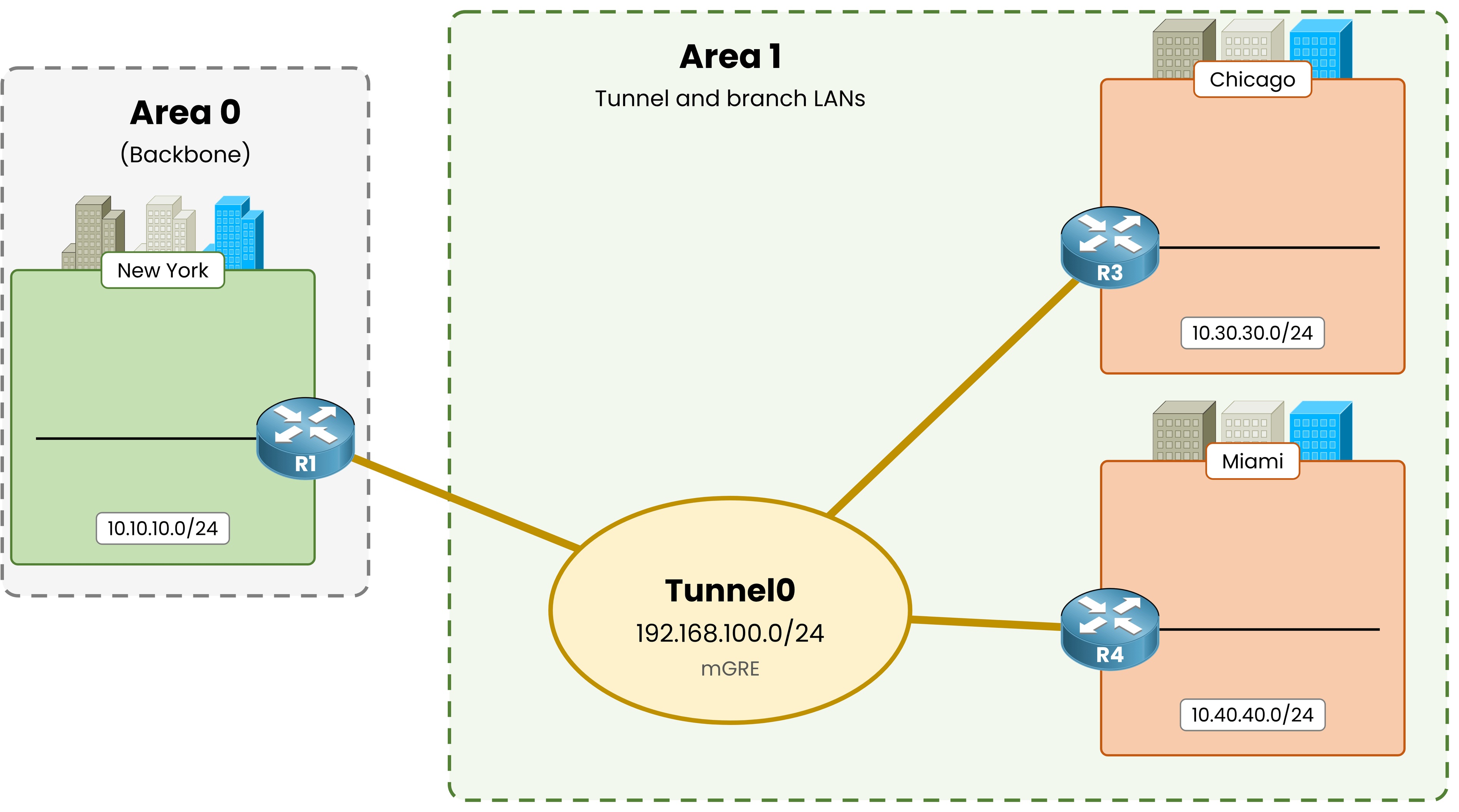
Figure 1 – Area 0 on the hub, area 1 on the tunnel
Configure the hub (R1):
R1# conf t
R1(config)# no router eigrp 100
R1(config)# router ospf 1
R1(config-router)# network 10.10.10.0 0.0.0.255 area 0
R1(config-router)# network 192.168.100.0 0.0.0.255 area 1
R1(config-router)# end
Configure both spokes with their LAN in area 1:
R3# conf t R3(config)# no router eigrp 100 R3(config)# router ospf 1 R3(config-router)# network 192.168.100.0 0.0.0.255 area 1 %OSPF-5-ADJCHG: Process 1, Nbr 203.0.113.1 on Tunnel0 from LOADING to FULL, Loading Done R3(config-router)# network 10.30.30.0 0.0.0.255 area 1 R3(config-router)# endR4# conf t R4(config)# no router eigrp 100 R4(config)# router ospf 1 R4(config-router)# network 192.168.100.0 0.0.0.255 area 1 %OSPF-5-ADJCHG: Process 1, Nbr 203.0.113.1 on Tunnel0 from LOADING to FULL, Loading Done R4(config-router)# network 10.40.40.0 0.0.0.255 area 1 R4(config-router)# endBoth spokes log a
FULLadjacency with the hub,203.0.113.1, as soon as the tunnel network statement is applied.Answer the question below
Click on Complete to continue
Point-to-Point Limitation on mGRE
Check the OSPF neighbor table on the hub:
R1# show ip ospf neighbor

Neighbor ID     Pri   State           Dead Time   Address         Interface
203.0.113.3       0   EXCHANGE/  -    00:00:33    192.168.100.3   Tunnel0
Run the command again a few seconds later: the neighbor changed. Check the hub log:
R1# show logging | include ADJCHG

%OSPF-5-ADJCHG: Process 1, Nbr 203.0.113.4 on Tunnel0 from EXCHANGE to DOWN, Neighbor Down: Adjacency forced to reset
%OSPF-5-ADJCHG: Process 1, Nbr 203.0.113.3 on Tunnel0 from EXCHANGE to DOWN, Neighbor Down: Adjacency forced to reset
%OSPF-5-ADJCHG: Process 1, Nbr 203.0.113.4 on Tunnel0 from EXCHANGE to DOWN, Neighbor Down: Adjacency forced to reset
Inspect the Tunnel0 OSPF settings on the hub:
R1# show ip ospf interface tunnel0
Tunnel0 is up, line protocol is up
  Internet Address 192.168.100.1/24, Area 1, Attached via Network Statement
  Process ID 1, Router ID 203.0.113.1, Network Type POINT_TO_POINT, Cost: 1000
  Topology-MTID    Cost    Disabled    Shutdown      Topology Name
        0           1000      no          no            Base
  Transmit Delay is 1 sec, State POINT_TO_POINT
  Timer intervals configured, Hello 10, Dead 40, Wait 40, Retransmit 5
    oob-resync timeout 40
    Hello due in 00:00:03
  Supports Link-local Signaling (LLS)
  Cisco NSF helper support enabled
  IETF NSF helper support enabled
  Index 1/2/2, flood queue length 0
  Next 0x0(0)/0x0(0)/0x0(0)
  Last flood scan length is 1, maximum is 1
  Last flood scan time is 0 msec, maximum is 0 msec
  Neighbor Count is 1, Adjacent neighbor count is 1
    Adjacent with neighbor 203.0.113.4
  Suppress hello for 0 neighbor(s)
A GRE tunnel defaults to point-to-point in OSPF. This network type expects a single neighbor.
With two spokes, the hub never completes the exchange: it resets one adjacency, starts the other, and loops.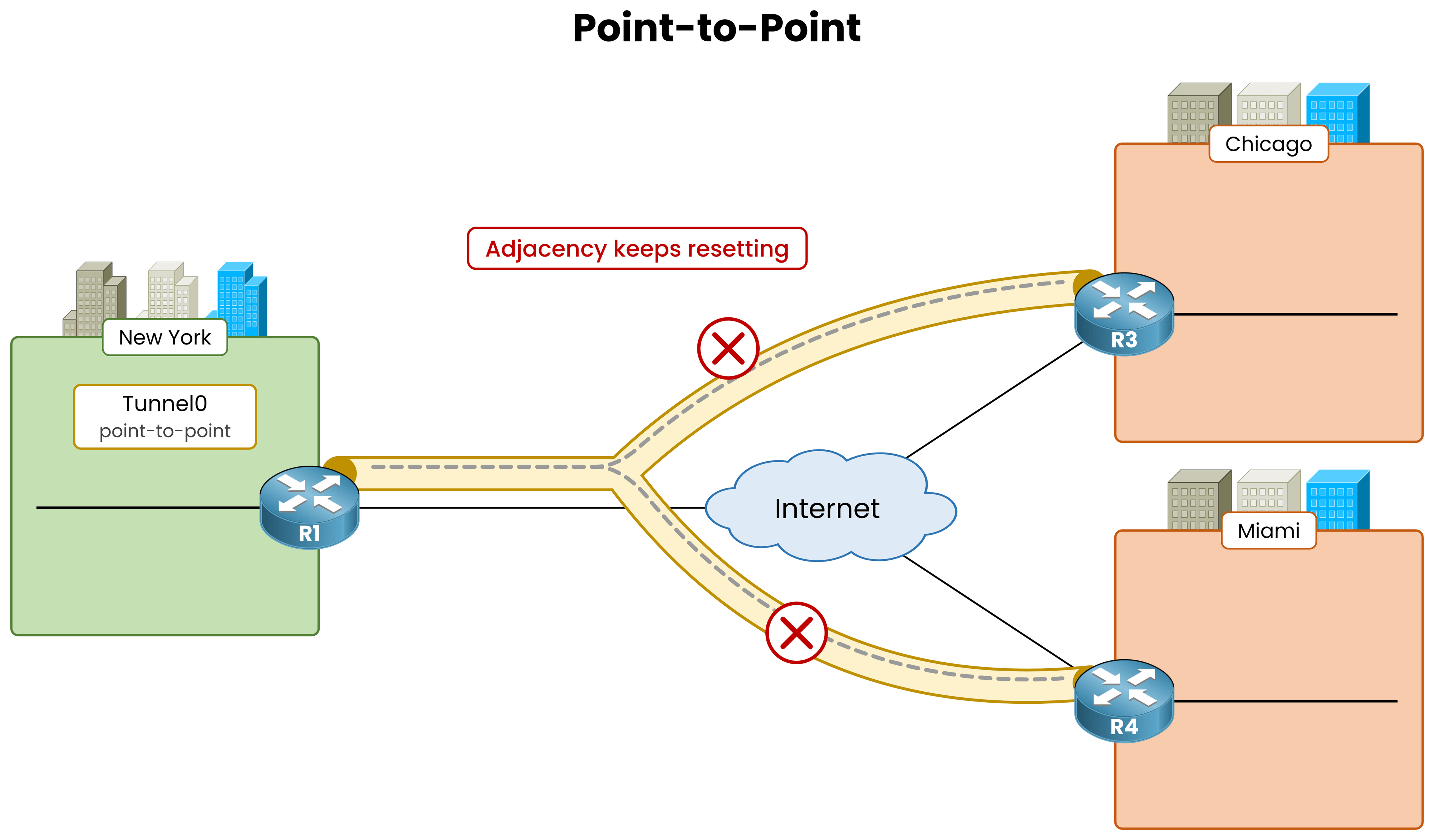
Figure 2 – Point-to-point: one neighbor at a time
Answer the question below
Which OSPF network type does the hub Tunnel0 use by default?
Answer the question below
What is the OSPF cost of Tunnel0?
To fix the neighbor adjacency issue on mGRE, use point-to-multipoint.
This mode is designed for hub-and-spoke topologies and removes the DR/BDR election.
Point-to-Multipoint Configuration
Configure point-to-multipoint mode on all three routers:
R1# conf t R1(config)# interface tunnel0 R1(config-if)# ip ospf network point-to-multipoint %OSPF-5-ADJCHG: Process 1, Nbr 203.0.113.4 on Tunnel0 from FULL to DOWN, Neighbor Down: Interface down or detached R1(config-if)# endR3# conf t R3(config)# interface tunnel0 R3(config-if)# ip ospf network point-to-multipoint %OSPF-5-ADJCHG: Process 1, Nbr 203.0.113.1 on Tunnel0 from LOADING to FULL, Loading Done R3(config-if)# endR4# conf t R4(config)# interface tunnel0 R4(config-if)# ip ospf network point-to-multipoint %OSPF-5-ADJCHG: Process 1, Nbr 203.0.113.1 on Tunnel0 from LOADING to FULL, Loading Done R4(config-if)# endVerify the neighbor states on the hub:
R1# show ip ospf neighbor

Neighbor ID     Pri   State           Dead Time   Address         Interface
203.0.113.3       0   FULL/  -        00:01:52    192.168.100.3   Tunnel0
203.0.113.4       0   FULL/  -        00:01:58    192.168.100.4   Tunnel0
Both adjacencies stay
FULLat the same time.
The
FULL/ -state confirms that the DR/BDR election is bypassed, and the dead time near 120 seconds reflects the point-to-multipoint default timers: 30-second hello, 120-second dead.Answer the question below
What is the OSPF dead interval, in seconds, on a point-to-multipoint interface?
Next-Hop Rewriting by the Hub
Inspect the OSPF routing table on Chicago (R3):
R3# show ip route ospf
Codes: L - local, C - connected, S - static, R - RIP, M - mobile, B - BGP
       D - EIGRP, EX - EIGRP external, O - OSPF, IA - OSPF inter area
       N1 - OSPF NSSA external type 1, N2 - OSPF NSSA external type 2
       E1 - OSPF external type 1, E2 - OSPF external type 2
       i - IS-IS, su - IS-IS summary, L1 - IS-IS level-1, L2 - IS-IS level-2
       ia - IS-IS inter area, * - candidate default, U - per-user static route
       o - ODR, P - periodic downloaded static route, H - NHRP, l - LISP
       a - application route
       + - replicated route, % - next hop override, p - overrides from PfR

Gateway of last resort is not set

      10.0.0.0/8 is variably subnetted, 4 subnets, 2 masks
O IA     10.10.10.0/24 [110/1001] via 192.168.100.1, 00:00:41, Tunnel0
O        10.40.40.0/24 [110/2001] via 192.168.100.1, 00:00:41, Tunnel0
      192.168.100.0/24 is variably subnetted, 4 subnets, 2 masks
O        192.168.100.1/32 [110/1000] via 192.168.100.1, 00:00:41, Tunnel0
O        192.168.100.4/32 [110/2000] via 192.168.100.1, 00:00:41, Tunnel0
Point-to-multipoint treats each peer connection as an individual link.
As a result, the hub sets itself as the next hop for all remote networks, such as
10.40.40.0/24, and injects a/32host route for each tunnel peer.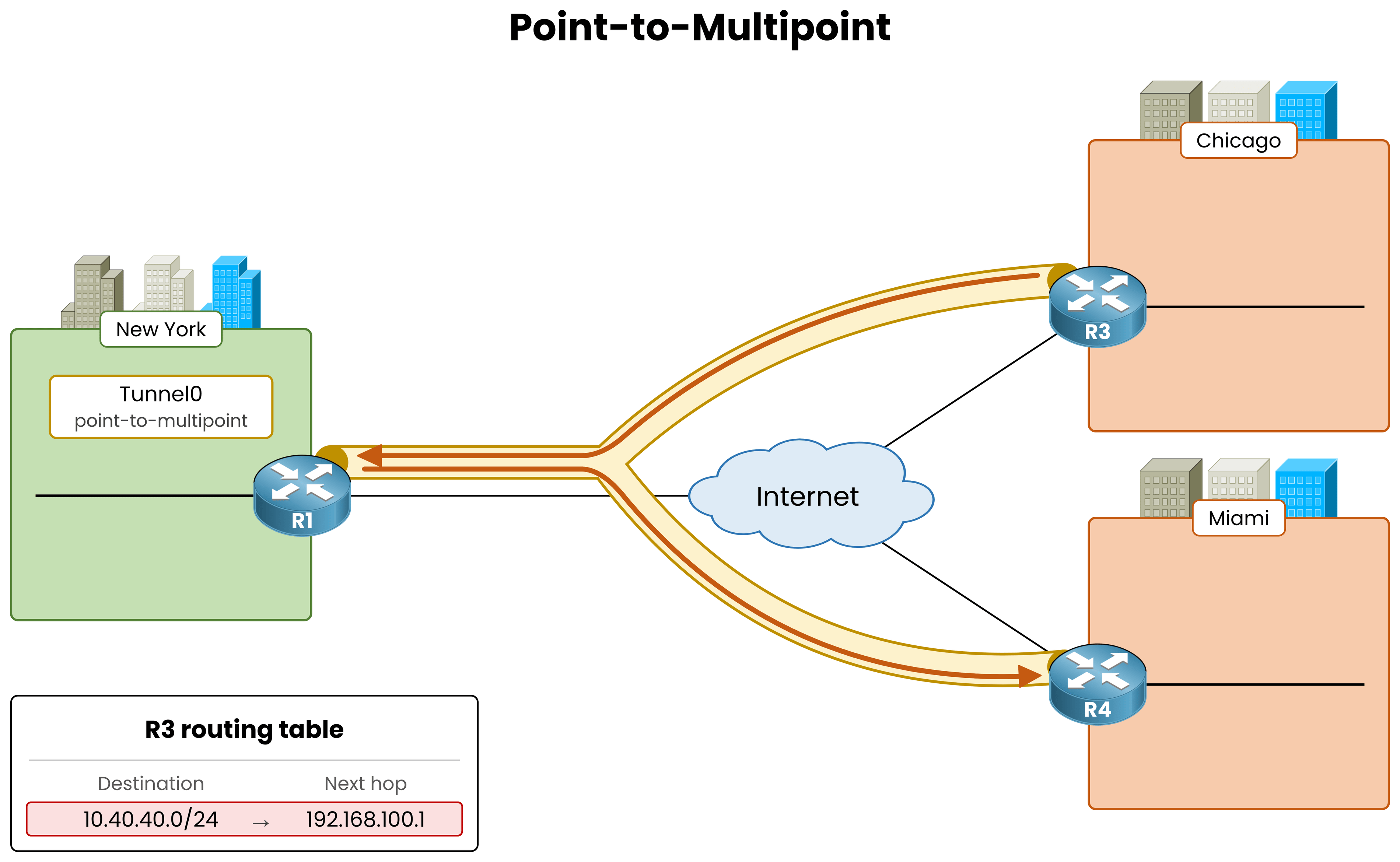
Figure 3 – Point-to-multipoint: the hub is the next hop
Answer the question below
What is the OSPF cost of 10.40.40.0/24 on R3 now?
Point-to-multipoint sets the hub as the routing next hop.
DMVPN Phase 3 uses NHRP redirects to shortcut spoke-to-spoke traffic in the data plane.First-Packet Hairpinning and Redirect
Run a traceroute from Chicago to Miami:
R3# traceroute 10.40.40.1 source 10.30.30.1
Type escape sequence to abort.
Tracing the route to 10.40.40.1
VRF info: (vrf in name/id, vrf out name/id)
  1 192.168.100.1 52 msec 52 msec 52 msec
  2 192.168.100.4 104 msec *  78 msec
The first packet passes through the hub,
192.168.100.1, and triggers an NHRP Redirect.
Every packet after that bypasses the hub and uses the direct spoke-to-spoke tunnel.Run the exact same traceroute a second time:
R3# traceroute 10.40.40.1 source 10.30.30.1
Type escape sequence to abort.
Tracing the route to 10.40.40.1
VRF info: (vrf in name/id, vrf out name/id)
  1 192.168.100.4 52 msec *  52 msec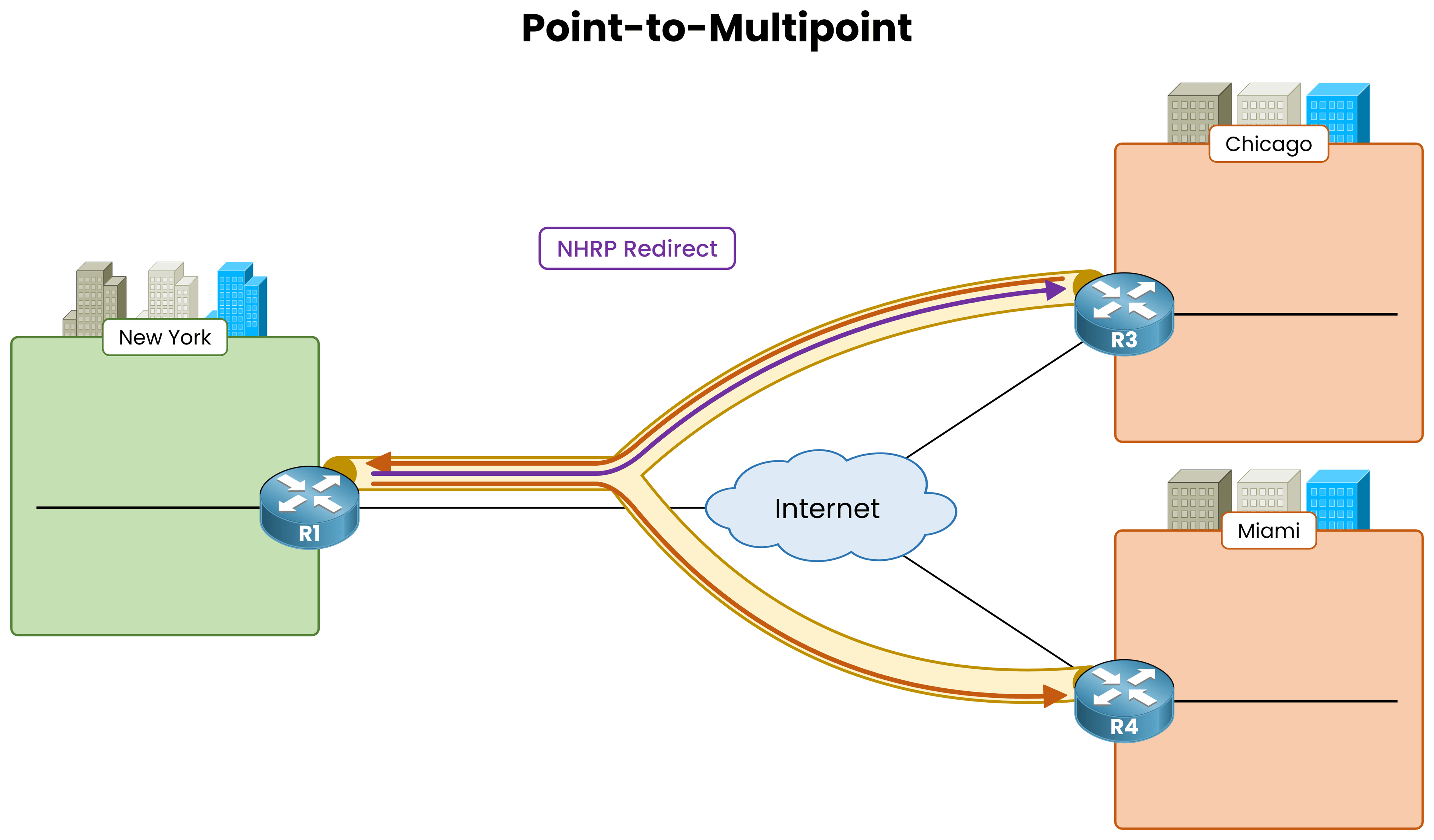
Figure 4 – NHRP Redirect from the hub
CEF and DMVPN Attribute Verification
Inspect the OSPF routing table on Chicago (R3):
R3# show ip route ospf Codes: L - local, C - connected, S - static, R - RIP, M - mobile, B - BGP D - EIGRP, EX - EIGRP external, O - OSPF, IA - OSPF inter area N1 - OSPF NSSA external type 1, N2 - OSPF NSSA external type 2 E1 - OSPF external type 1, E2 - OSPF external type 2 i - IS-IS, su - IS-IS summary, L1 - IS-IS level-1, L2 - IS-IS level-2 ia - IS-IS inter area, * - candidate default, U - per-user static route o - ODR, P - periodic downloaded static route, H - NHRP, l - LISP a - application route + - replicated route, % - next hop override, p - overrides from PfR Gateway of last resort is not set 10.0.0.0/8 is variably subnetted, 4 subnets, 2 masks O IA 10.10.10.0/24 [110/1001] via 192.168.100.1, 00:03:10, Tunnel0 O % 10.40.40.0/24 [110/2001] via 192.168.100.1, 00:03:10, Tunnel0 192.168.100.0/24 is variably subnetted, 4 subnets, 2 masks O 192.168.100.1/32 [110/1000] via 192.168.100.1, 00:03:10, Tunnel0 O % 192.168.100.4/32 [110/2000] via 192.168.100.1, 00:03:10, Tunnel0%symbol: NHRP installed a next-hop override in CEF. The routing table keeps the hub,192.168.100.1, as the control-plane next hop.
Check the CEF entry for the Miami LAN:
R3# show ip cef 10.40.40.1
10.40.40.0/24
  nexthop 192.168.100.4 Tunnel0
Data-plane forwarding: CEF overrides the routing table and forwards traffic for
10.40.40.1directly to Miami,192.168.100.4.
Check the DMVPN peer table on Chicago:
R3# show dmvpn Legend: Attrb --> S - Static, D - Dynamic, I - Incomplete N - NATed, L - Local, X - No Socket T1 - Route Installed, T2 - Nexthop-override C - CTS Capable, I2 - Temporary # Ent --> Number of NHRP entries with same NBMA peer NHS Status: E --> Expecting Replies, R --> Responding, W --> Waiting UpDn Time --> Up or Down Time for a Tunnel ========================================================================== Interface: Tunnel0, IPv4 NHRP Details Type:Spoke, NHRP Peers:2, # Ent Peer NBMA Addr Peer Tunnel Add State UpDn Tm Attrb ----- --------------- --------------- ----- -------- ----- 2 203.0.113.4 192.168.100.4 UP 00:00:37 DT2 203.0.113.4 192.168.100.4 UP 00:00:37 DT2 1 203.0.113.1 192.168.100.1 UP 00:35:02 SDT2attribute (Nexthop-override): NHRP installed an override on the explicit OSPF routes,10.40.40.0/24and192.168.100.4/32, instead of creating a new route.
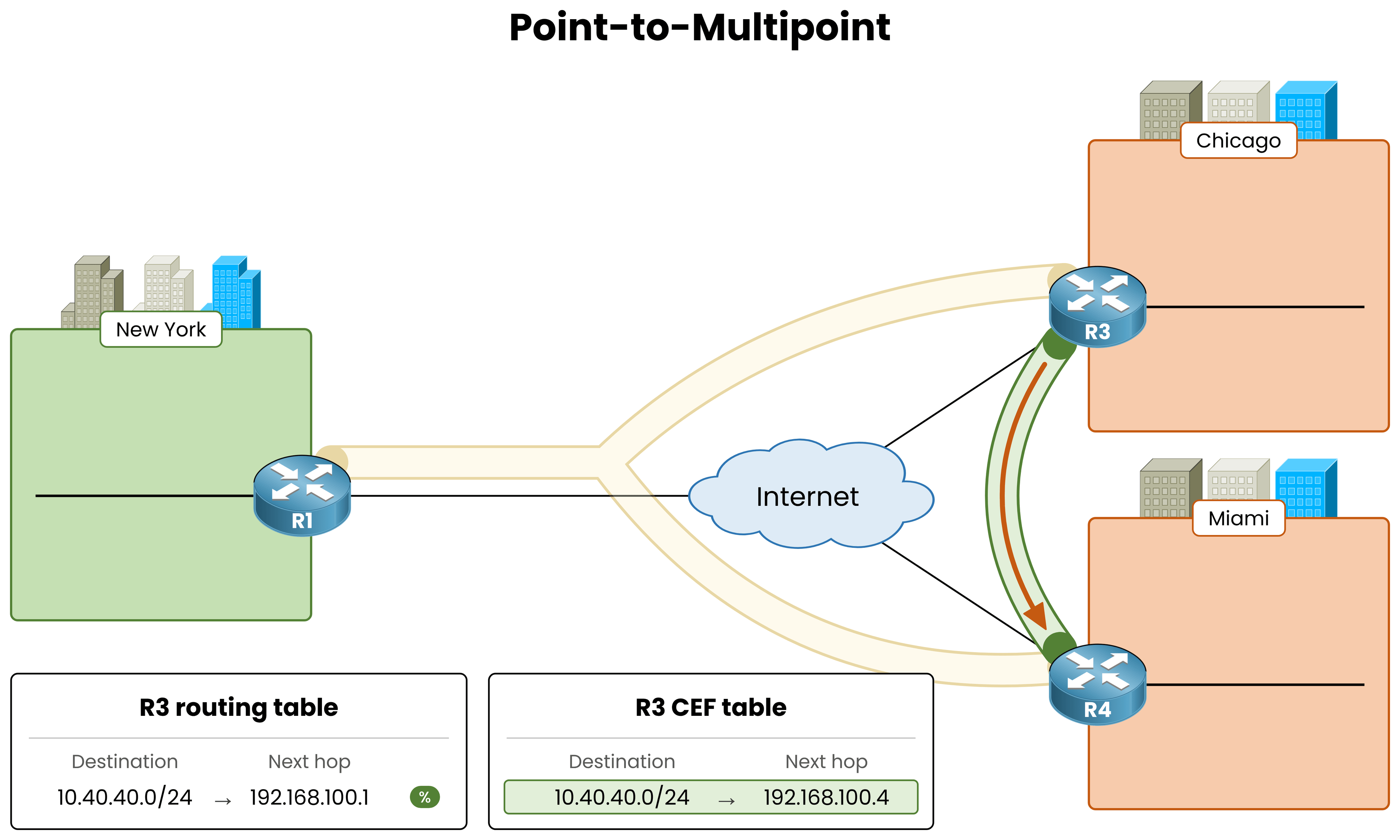
Figure 5 – CEF overrides the next hop
Answer the question below
How many Miami entries in show dmvpn carry the DT2 attribute?
Answer the question below
Which next hop does CEF use for 10.40.40.1?
Direct spoke-to-spoke traffic works.
The remaining question, the one from the EIGRP lesson, is routing table size: how small can the spoke routing table get?EIGRP summarizes on any interface. OSPF floods LSAs throughout an area and summarizes only on an ABR, between two areas.
The branch LANs share area 1 with the tunnel, so the hub cannot summarize them for the other spokes.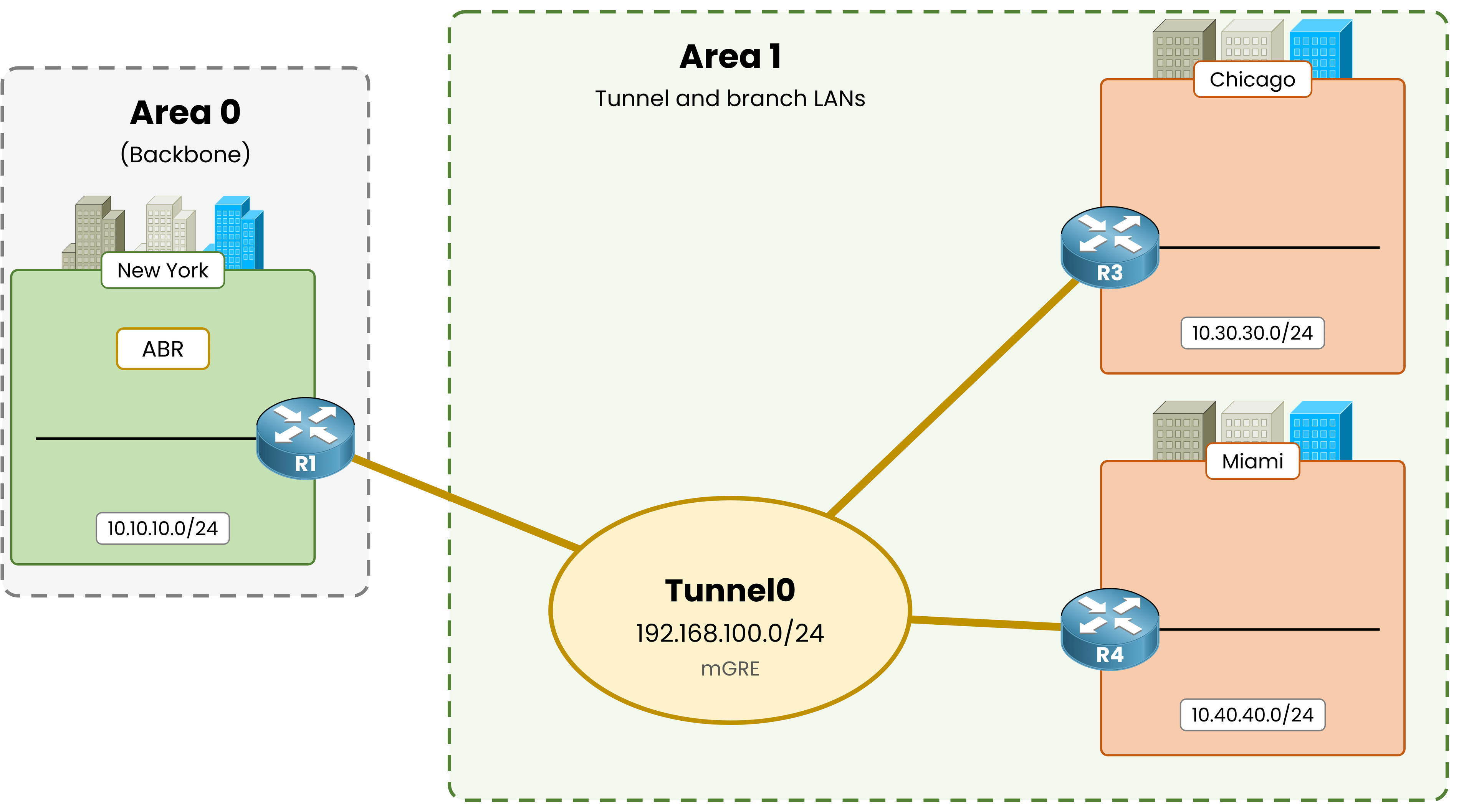
Figure 6 – The hub is the only ABR
Totally Stubby Area Implementation
To reduce the routing table on the spokes, configure area 1 as a totally stubby area.
The hub blocks the inter-area routes,O IA, and injects a default route,O*IA.Configure the hub (R1):
R1# conf t
R1(config)# router ospf 1
R1(config-router)# area 1 stub no-summary
%OSPF-5-ADJCHG: Process 1, Nbr 203.0.113.3 on Tunnel0 from FULL to DOWN, Neighbor Down: Adjacency forced to reset
%OSPF-5-ADJCHG: Process 1, Nbr 203.0.113.4 on Tunnel0 from FULL to DOWN, Neighbor Down: Adjacency forced to reset
R1(config-router)# end
Configure both spokes as stub areas to match:
R3# conf t R3(config)# router ospf 1 R3(config-router)# area 1 stub %OSPF-5-ADJCHG: Process 1, Nbr 203.0.113.1 on Tunnel0 from LOADING to FULL, Loading Done R3(config-router)# endR4# conf t R4(config)# router ospf 1 R4(config-router)# area 1 stub %OSPF-5-ADJCHG: Process 1, Nbr 203.0.113.1 on Tunnel0 from LOADING to FULL, Loading Done R4(config-router)# endVerify the routing table on Chicago (R3):
R3# show ip route ospf
Codes: L - local, C - connected, S - static, R - RIP, M - mobile, B - BGP
       D - EIGRP, EX - EIGRP external, O - OSPF, IA - OSPF inter area
       N1 - OSPF NSSA external type 1, N2 - OSPF NSSA external type 2
       E1 - OSPF external type 1, E2 - OSPF external type 2
       i - IS-IS, su - IS-IS summary, L1 - IS-IS level-1, L2 - IS-IS level-2
       ia - IS-IS inter area, * - candidate default, U - per-user static route
       o - ODR, P - periodic downloaded static route, H - NHRP, l - LISP
       a - application route
       + - replicated route, % - next hop override, p - overrides from PfR

Gateway of last resort is 192.168.100.1 to network 0.0.0.0

O*IA  0.0.0.0/0 [110/1001] via 192.168.100.1, 00:00:19, Tunnel0
      10.0.0.0/8 is variably subnetted, 3 subnets, 2 masks
O   %    10.40.40.0/24 [110/2001] via 192.168.100.1, 00:00:19, Tunnel0
      192.168.100.0/24 is variably subnetted, 4 subnets, 2 masks
O        192.168.100.1/32 [110/1000] via 192.168.100.1, 00:00:19, Tunnel0
O   %    192.168.100.4/32 [110/2000] via 192.168.100.1, 00:00:19, Tunnel0
O*IA 0.0.0.0/0replaces10.10.10.0/24and all prefixes behind the hub.However,
10.40.40.0/24remains with its%override: intra-area routes cannot be filtered inside area 1, so the spoke-to-spoke routes do not shrink.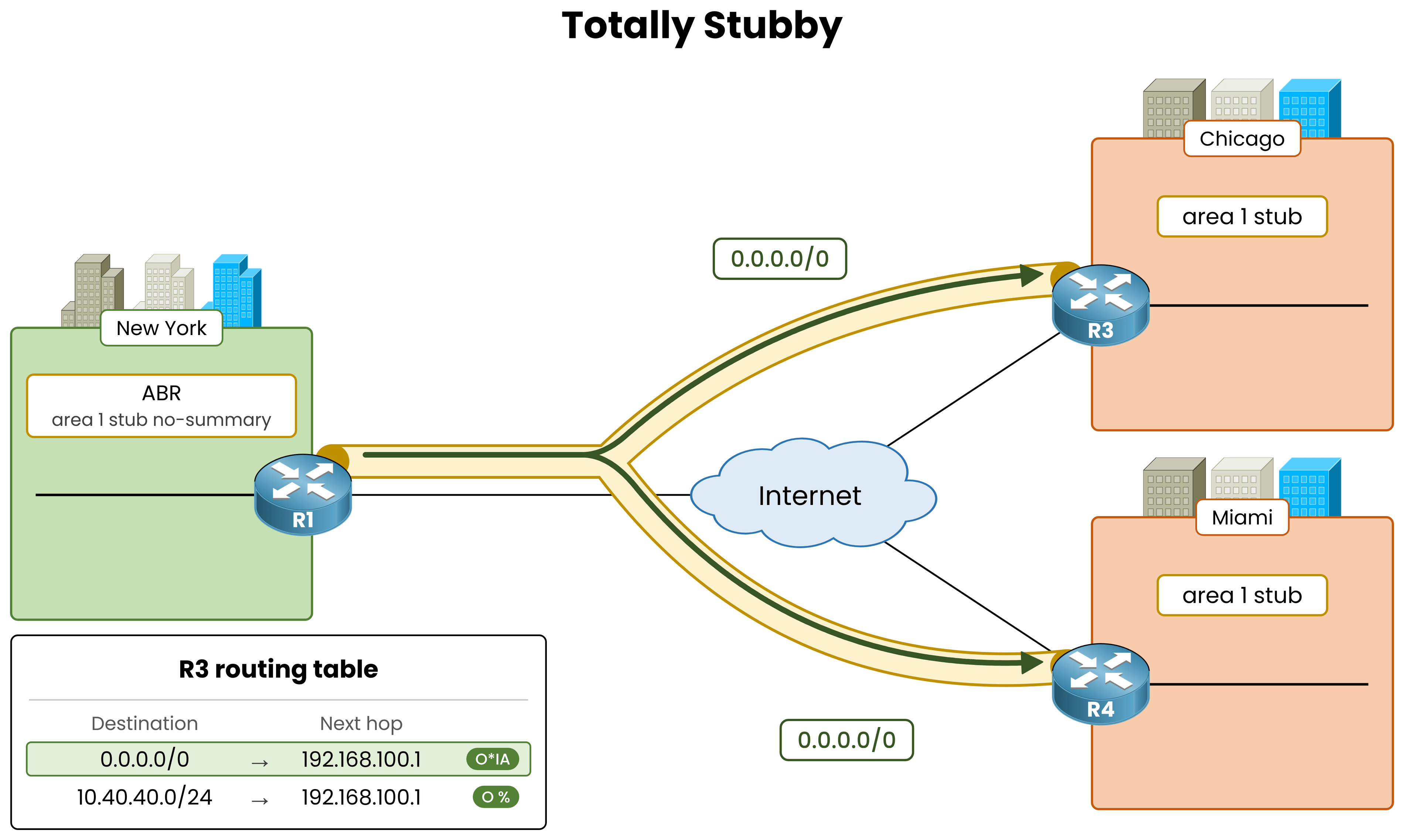
Figure 7 – Totally stubby area 1
Answer the question below
Which route code marks the default route on R3?
Answer the question below
Which LAN disappeared from the R3 routing table after the no-summary keyword?
EIGRP vs OSPF Scalability Comparison
Compare both Phase 3 designs on a 300-site network:
Routing Protocol
Routes per Spoke
Spoke-to-Spoke Traffic
EIGRP, Phase 3
1 default route + NHRP routes for active flows
Direct
OSPF, Phase 3
1 default route + 299 intra-area routes
Direct
Table 1 – Routes held by one spoke in a 300-site DMVPN Phase 3
OSPF Phase 3 provides direct spoke-to-spoke paths, but cannot match the EIGRP route reduction on the spokes.
Production Design Note: avoid stub areas on branches with Direct Internet Access. The injected default route forces all Internet traffic through the hub. Keep area 1 standard and summarize the core networks on the hub with
area 0 range 10.0.0.0 255.0.0.0.Key Takeaway
Always change the mGRE tunnel network type to point-to-multipoint: it prevents dropped neighbors and bypasses the DR election.
DMVPN Phase 3 relies on NHRP redirects to shortcut the data path, while OSPF keeps the hub as the control-plane next hop.
OSPF summarizes strictly on ABRs. A totally stubby area removes the core routes, but the intra-area spoke routes remain explicit.
Answer the question below
In a 300-site DMVPN Phase 3 with OSPF, how many intra-area routes does a spoke hold for the other branches?
Answer the question below
Which OSPF network type is recommended on a DMVPN Phase 3 tunnel?