'%3e%3crect%20width='398'%20height='248'%20fill='%23fff'/%3e%3cg%20transform='translate(115%2040)%20scale(7)'%20fill='%23102A43'%3e%3cpath%20d='M11%2019.425v-6.85L5%209.1v6.85zm2%200l6-3.475V9.1l-6%203.475zm-1-8.575l5.925-3.425L12%204L6.075%207.425zM4%2017.7q-.475-.275-.737-.725t-.263-1v-7.95q0-.55.263-1T4%206.3l7-4.025Q11.475%202%2012%202t1%20.275L20%206.3q.475.275.738.725t.262%201v7.95q0%20.55-.262%201T20%2017.7l-7%204.025Q12.525%2022%2012%2022t-1-.275zm8-5.7'/%3e%3c/g%3e%3c/g%3e%3c/svg%3e)

Becoming a Network Engineer
Network engineers build the thing every other job depends on. Applications, phones, badge readers, the wifi in the meeting room: none of it exists without someone designing the paths underneath.
Every company runs on a network, and someone has to build it. That's this job.

When it works, nobody thinks about it. When it doesn't, the entire building stops, and one person is expected to know why. That responsibility is exactly why the role pays what it does.
Before we go any further, there are three myths worth killing right away:
I need a degree to become a Network Engineer. Not true. Networking is one of the few technical fields where a certification and a topology you can actually build beat a diploma on a CV. Most engineers doing this today came through helpdesk, an apprenticeship, or a career change from something completely unrelated.
I need real Cisco gear at home to practise. Also not true. Packet Tracer covers almost everything in the CCNA and runs on the laptop you already own. You can build an enterprise network, break it on purpose, and fix it, without spending anything on hardware.
I have to be naturally good at subnetting. Subnetting is arithmetic with a pattern. Ten minutes a day for two weeks and it stops being the thing you're afraid of. Everyone who does this for a living was slow at it once.
So what are you waiting for?
Read on as we break down each step to becoming a Network Engineer and starting your career.
What is a Network Engineer?
A Network Engineer designs, builds and keeps running the infrastructure everything else depends on. If it carries traffic, it's yours.
The work splits roughly in two. There's the building: new sites, new floors, new VLANs, migrations, replacing hardware that reached end of support. And there's the keeping alive: someone reports that something is slow, and you find out whether it's the network, and if it is, exactly where.
A normal week: bringing a new branch office online, working out why one floor's calls keep dropping while everyone else is fine, planning the IP addressing for a building that doesn't exist yet, replacing a core switch during a 2am maintenance window and watching everything come back up clean.
Strip all of that back and the job is one path. A laptop on someone's desk at one end, the internet at the other, and a handful of boxes in between. Learn what each one does and you have the map you will use for the rest of your career.
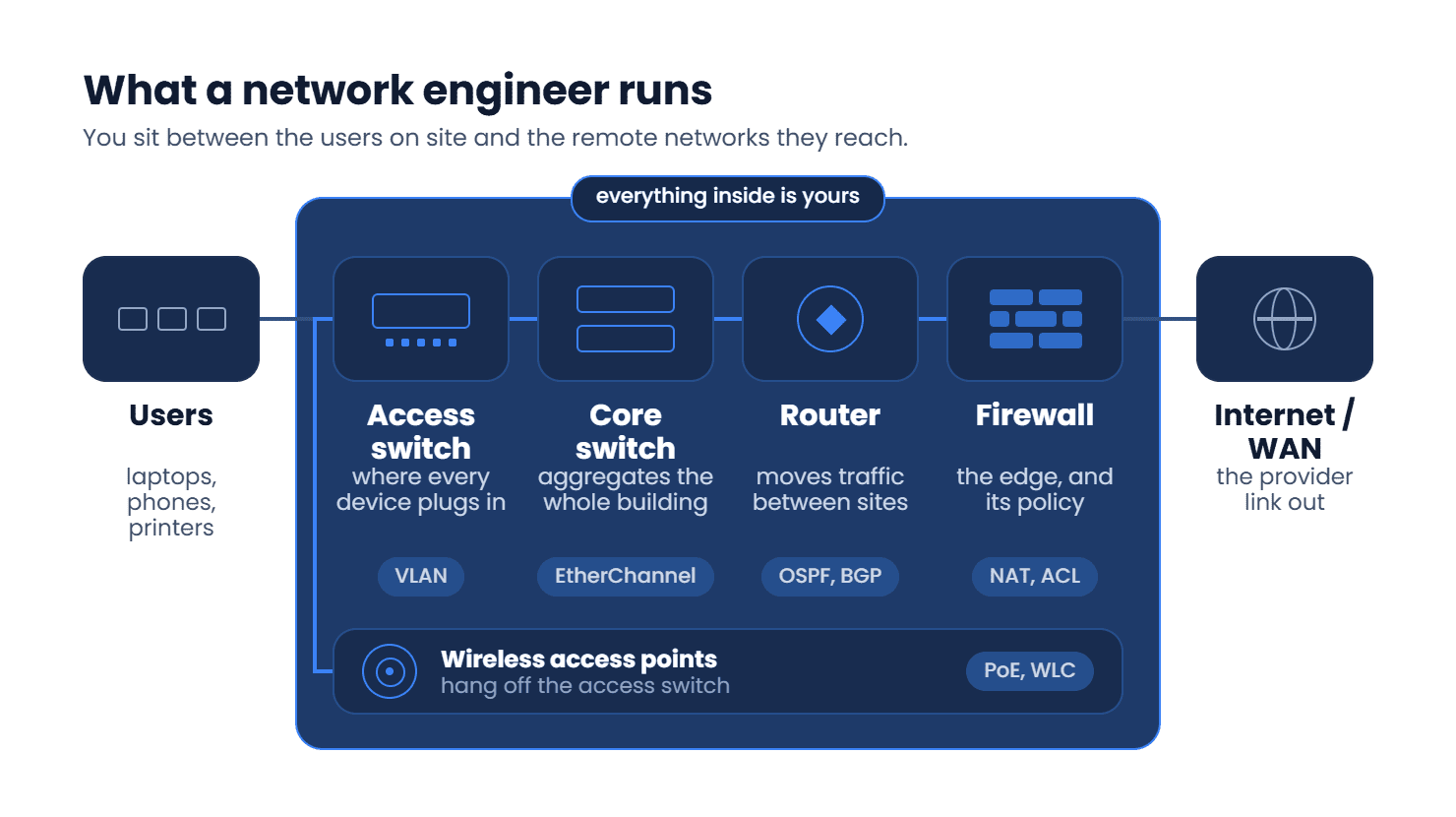
The part people underestimate is what happens when one of those boxes stops doing its job and nobody knows which one. It doesn't stop at the helpdesk and it isn't the developer's problem. It lands on you, because you're the one who can read what the traffic is actually doing and say where it went wrong.
Where you do it changes the job a lot. In-house means one network you know intimately and improve over years. An integrator or managed service provider means many client networks, faster rotation, and far more variety early on. A service provider means scale and routing depth most enterprises never touch.
This is rarely a first job in IT. Most people arrive from helpdesk, a NOC, or system administration, because you need to have seen how a company actually breaks before you can design around it. That's an advantage rather than a delay: the CCNA turns experience you already have into a change of title.
Once you're in, you have two directions. Wider, taking on more of the network each year until you are the one deciding what gets built. Or deeper, into a specialism where the pay follows the scarcity. Junior engineers start on low risk changes and helpdesk escalations, then get handed a full site once people trust their hands.
Why become a Network Engineer?
As an entry point into infrastructure, this role builds skills that stay valuable no matter where technology goes. You will:
Build a mental model of how systems actually communicate, which makes you better at cloud, security and DevOps later
Own real infrastructure early, with visible impact the day a site comes online because of your work
Develop a troubleshooting method that transfers to every technical job you will ever hold
Sit between the business and the machines, translating one for the other
And given the responsibility involved, the salary curve starts high and steps up with each certification tier.
Is a Network Engineer role a suitable fit for me?
Do you want to know why something works, not just that it works? Does a problem nobody else can solve make you more interested rather than less? Are you the person who reads the log instead of rebooting?
If you answered yes to these questions, this career path might be just right for you.
And what about the soft skills? How do you know if you're the right kind of person to work as a network engineer?
Calm: a site is down, three people are asking for updates, and you still work the problem in order instead of changing five things at once.
Methodical: you change one thing, you check what it did, you write it down. Guessing works right up until the day it doesn't.
Curious: "it works now" isn't good enough for you. You want to know what actually fixed it, because otherwise it comes back next month.
Comfortable being last in line: when a problem reaches you there is nobody left to escalate to. Some people hate that. Some people live for it.
Clear in writing: you will explain to a non-technical manager why a fifteen minute outage was necessary, in a sentence they can repeat to their own boss.
Patient: some faults only appear every third Tuesday. Finding those is what separates you from a script.
Skills for a Network Engineer
Read enough job descriptions and the usual suspects start to crop up. Let's break down the core capabilities required.
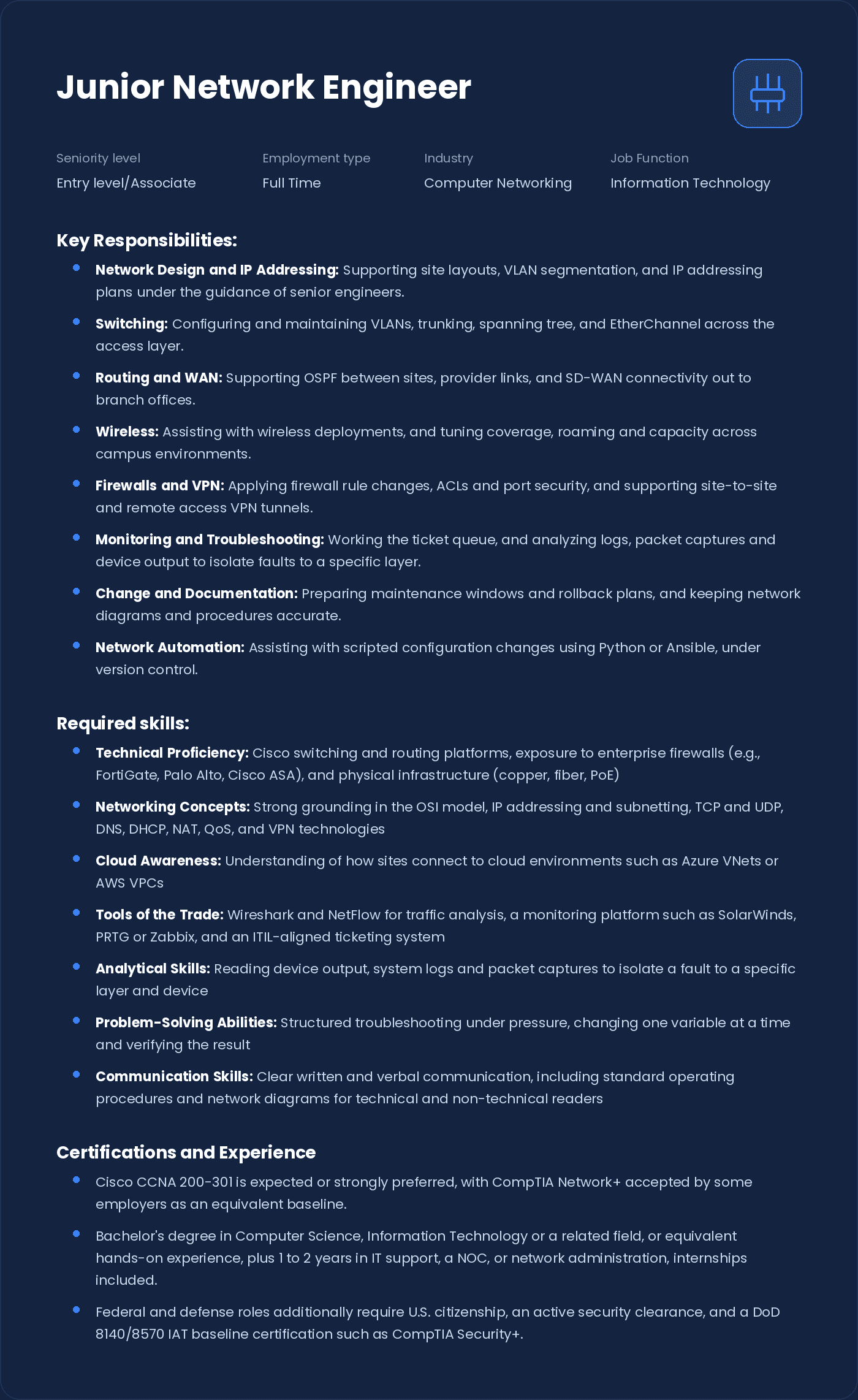
As an entry-level Network Engineer, your role involves supporting the design, deployment and operation of a company's network infrastructure. You will work alongside senior engineers and IT teams on:
Network Design and IP Addressing — Laying out a site before anything is racked. VLANs per function, an addressing plan that still makes sense in three years, and room to grow.
Switching — The access layer where users plug in. VLANs, trunking, spanning tree, EtherChannel, and the port that keeps flapping for reasons nobody documented.
Routing and WAN — Moving traffic between sites and out to the internet. Static routes where they make sense, OSPF where they don't, enough BGP to talk to your provider without fear, and SD-WAN links out to branch offices.
Wireless — Coverage, roaming and capacity. Half of wireless work is radio, the other half is the wired network sitting behind it.
Firewalls and VPN — Firewall policy, ACLs and port security, segmentation between users and servers, and the VPN tunnels that connect remote sites and remote workers.
Monitoring and Troubleshooting — Knowing something is wrong before the tickets arrive. Reading a capture, following a path hop by hop, proving exactly where the packet stops.
Change and Documentation — Maintenance windows, rollback plans, and diagrams that match reality. The engineer who documents is the one trusted with the core.
Network Automation — Pushing the same configuration to forty switches by hand is how mistakes get made. Python and Ansible are no longer bonus skills.
Required Skills:
Technical Proficiency — Cisco switching and routing platforms, exposure to enterprise firewalls (FortiGate, Palo Alto, Cisco ASA), and physical infrastructure (copper, fiber, PoE)
Networking Concepts — Strong grounding in the OSI model, IP addressing and subnetting, TCP and UDP, DNS, DHCP, NAT, QoS, and VPN technologies
Cloud Awareness — Understanding of how sites connect to cloud environments such as Azure VNets or AWS VPCs
Tools of the Trade — Wireshark and NetFlow for traffic analysis, a monitoring platform such as SolarWinds, PRTG or Zabbix, and an ITIL-aligned ticketing system
Analytical Skills — Reading device output, system logs and packet captures to isolate a fault to a specific layer and device
Problem-Solving Abilities — Structured troubleshooting under pressure, changing one variable at a time and verifying the result
Communication Skills — Clear written and verbal communication to report incidents, justify changes, and work with teams who don't share your vocabulary
Certifications — Cisco CCNA 200-301 is expected or strongly preferred by most employers, with CCNP valued for the professional tier
Check out the example job description for a Junior Network Engineer below!
What Do I Need to Learn to Become a Network Engineer?
Want to learn how to become a Network Engineer? Well, at some point we've got to ditch the theory and get our hands dirty, right?
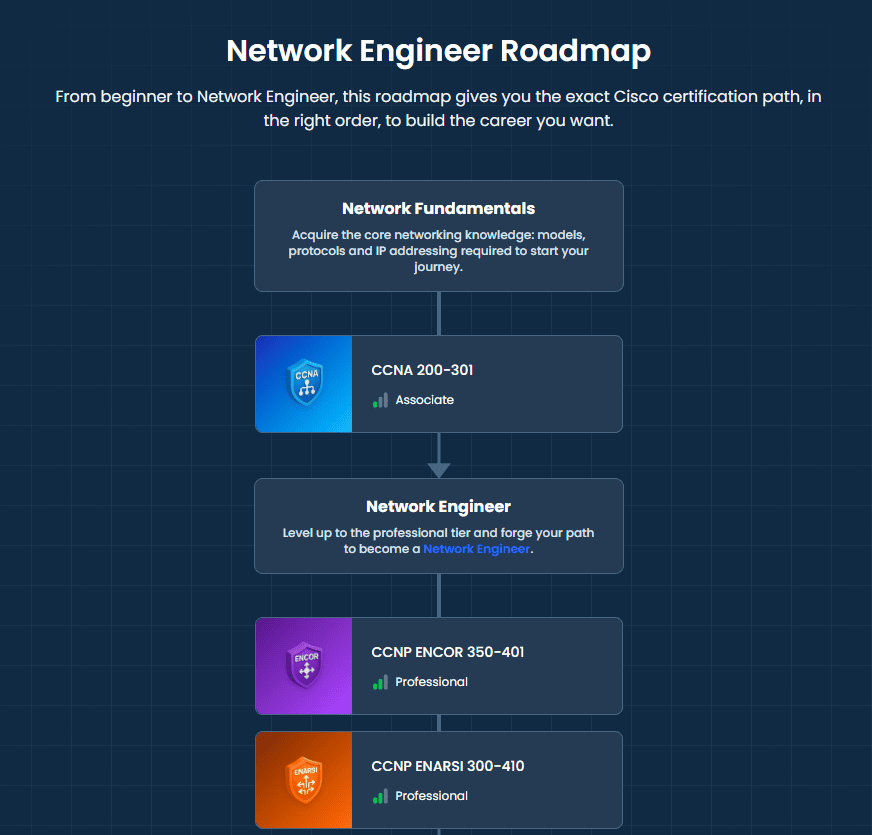
PingMyNetwork gives you the exact Cisco path, in the right order. Start with CCNA 200-301: it assumes nothing and takes you from what a MAC address is to a fully routed and switched network. From there, CCNP ENCOR 350-401 and CCNP ENARSI 300-410 take you into the professional tier, where design decisions and advanced routing live.
Every lesson ends in a lab, because reading about OSPF and configuring OSPF are two different skills, and only one of them survives an interview. You build the topology, you break it, you fix it. Mock exams run under exam conditions so the real day holds no surprises.
If you're starting with zero technical knowledge, that's the normal starting point here. The CCNA path is built for it.
Seeking a Network Engineer role? Here's everything to know!
Now that you have the skills and know the demands of the role, it's time to see what's out there.
While you can dive straight into a job board, there are a few realities worth weighing first.
Maintenance windows
Core changes get done when the business is asleep, so a few nights a year are part of the deal. In exchange your normal days are calm, and most employers give the time back.
The network gets blamed first
Application slow, printer offline, video call frozen. It's the network until you prove otherwise. Learning to prove otherwise in five minutes is a genuine career skill, and it's how junior engineers earn trust fast.
Documentation is always behind
You will inherit diagrams that stopped being true two years ago. Fixing that is the fastest way to become indispensable in a new job, and it costs nothing but attention.
Work/Life Balance
Compared to a SOC analyst on rotating shifts, this is a steady weekday role for most people, most of the time. On-call exists, but it's usually a rota rather than a lifestyle.
Variety
Campus, wireless, data centre, WAN, cloud connectivity. Each comes with its own failure modes, and you can move between them without changing career.
Get the Job!
You've decided a Network Engineer career is right for you and you've completed the CCNA 200-301 path. What now?
Apply before you feel ready. Junior roles go to people who can explain their reasoning, not to people who have memorised every command. If you can walk an interviewer through a topology you built, what broke, and how you found it, you're already ahead of most candidates holding the same certification.
Have two or three real stories ready. A lab that refused to work and what the fix turned out to be is worth more in an interview than a flawless recitation of the OSI model.
And if you feel you're still not quite there, no problem. Go back through the labs, redo the ones you finished by copying, and come back when you can do them without the instructions.
Get Started: Tips from Network Engineers
Let's hear from engineers doing the job. Here are their tips for the first few months.
Likely first tasks
Reading the existing topology and finding out where it's wrong
Small, low risk changes: a VLAN, an access port, a firewall rule
Shadowing a senior engineer through a real maintenance window
Taking escalations from the helpdesk
Sitting in on site visits and cabling work
Learning the monitoring platform before you need it
Onboarding tips
Learn the naming conventions and the IP plan before anything else
Find out who approves a change, and how far in advance
Productivity tips
Keep your own notes from day one, separate from the official documentation
Save every useful show command and script you write